What a Tyneside flat is and why the loft matters
Walk down almost any terraced street in Heaton, Byker, Walker, Wallsend or Bensham and you will see front doors grouped in pairs, one opening into the ground floor flat, the other onto a staircase running straight up to the flat above. That is the Tyneside flat: two purpose-built single-storey flats stacked inside what looks from the street like an ordinary two-storey terrace, each with its own front door and no shared hallway at all.
The type is unique to this corner of England. The earliest examples went up in Gateshead in 1866, and construction ran hard from the 1880s until 1914, driven by the shipyards and engineering works pulling workers into Newcastle and Gateshead. By 1900 roughly half of all new homes being built on Tyneside were flats of this type, and while nobody keeps an exact register today, Newcastle City Council has estimated around 2,800 survive in Heaton alone. The surviving stock across Tyneside runs well into the tens of thousands.
The loft matters because the upper flat sits directly beneath the whole roof void, under a reasonably steep Victorian pitch, and that void is its only realistic direction to grow. With no side return, a small rear yard often split with the flat below and a fixed street frontage, the roof space is the spare room nobody built.
Can you convert the loft of a Tyneside flat?
Yes. Upper Tyneside flats are converted every year, and the payoff is bigger than on almost any other loft project in the North East: a one-storey two-bedroom flat becomes a two-storey home with three or four bedrooms.
The caveat is that a Tyneside flat conversion passes through three gates a normal terraced house never meets.
Gate one is ownership. You need to establish exactly what your lease includes and what your downstairs neighbour has to consent to, and the title documents settle this.
Gate two is planning. Flats hold no permitted development rights, so every Tyneside flat loft conversion needs a planning application, even for a simple rooflight scheme.
Gate three is the build. You are adding a storey to a building somebody else partly owns and lives in, which brings the Party Wall Act, stricter fire regulations and back-lane access into play.
None of these gates is a wall, but they are sequencing problems, and the projects that go wrong almost always took them in the wrong order. Before any of it, measure the loft: a dormer scheme wants roughly 2.2 metres from the ceiling joists to the underside of the ridge. Once you know the loft measures up, the dormer type you choose sets how much of that headroom becomes usable floor.
Who owns the loft: leases, criss-cross freeholds and your neighbour
Most Tyneside flats sit on a legal structure that barely exists anywhere else in England, usually called a criss-cross or North Tyneside flat lease. Each owner holds a long lease of their own flat, typically 999 years at a peppercorn rent, and owns the freehold of the other flat in the pair, so each can enforce the lease covenants against the other. Your downstairs neighbour is your freeholder and you are theirs.
Under the standard scheme the upper flat's lease usually includes its staircase, the roof and the roof void, while the ground floor flat includes the foundations. That position favours converters, but it is not guaranteed. Some leases stop the upper demise at ceiling level, older deeds can be silent about the void, and a minority of pairs use the South Tyneside variant, where one owner holds the freehold of the whole building. Step one is ordering official copies of both titles from HM Land Registry, a few pounds online, then having a conveyancer confirm the demise.
Even where the void is clearly yours, the lease will almost always restrict structural alterations without the freeholder's consent. In practice the neighbour signs a licence for alterations, or a deed of variation where the void first has to be brought into your demise. Budget £1,500 to £3,000 in legal fees across both sides, more where a payment is negotiated for the space itself.
The Party Wall etc. Act 1996 runs alongside. The party walls on both sides take the new steelwork and the floor between the flats is a party structure in its own right, so notices go to every adjoining owner, meaning your downstairs neighbour plus several owners either side. Serve notices at least two months before the planned start and budget £900 to £1,500 per award if a neighbour dissents.
Planning permission: why every Tyneside flat conversion needs an application
The permitted development regime that lets most Newcastle homeowners build a rear dormer without an application does not apply here, and the reason deserves precision. Roof enlargements are permitted under Schedule 2, Part 1, Class B of the Town and Country Planning (General Permitted Development) (England) Order 2015. Part 1 applies only to dwellinghouses, and the Order's definition of a dwellinghouse excludes flats and buildings containing flats. A Tyneside flat therefore has no Class B rights and no other householder permitted development rights. Newcastle City Council's Householder Design Guide puts it in terms: "Any external alterations to flats including Tyneside flats will require planning permission."
So every Tyneside flat loft conversion needs a full planning application, whether the scheme is a full-width dormer or two rooflights. The fee for altering a single dwelling doubled from £258 to £528 in April 2025, and annual indexation lifted it to £548 from 1 April 2026. Determination takes around eight weeks from validation. A Lawful Development Certificate has no role here, since there is no permitted development for it to confirm.
Which council you apply to depends on the address. Newcastle City Council covers Heaton, Byker, Sandyford and Walker. North Tyneside Council covers Wallsend, North Shields and Whitley Bay. Gateshead Council covers Bensham, and South Tyneside Council covers South Shields.
On design, a rear dormer kept in proportion and clad to sit comfortably with the existing roof is the scheme planners approve week in, week out. The same guide warns that flat-roofed dormers on front elevations will not normally be acceptable. Check the council's conservation area maps before commissioning drawings, since pockets of the Tyneside flat belt carry extra controls.
The design and build reality on a shared building
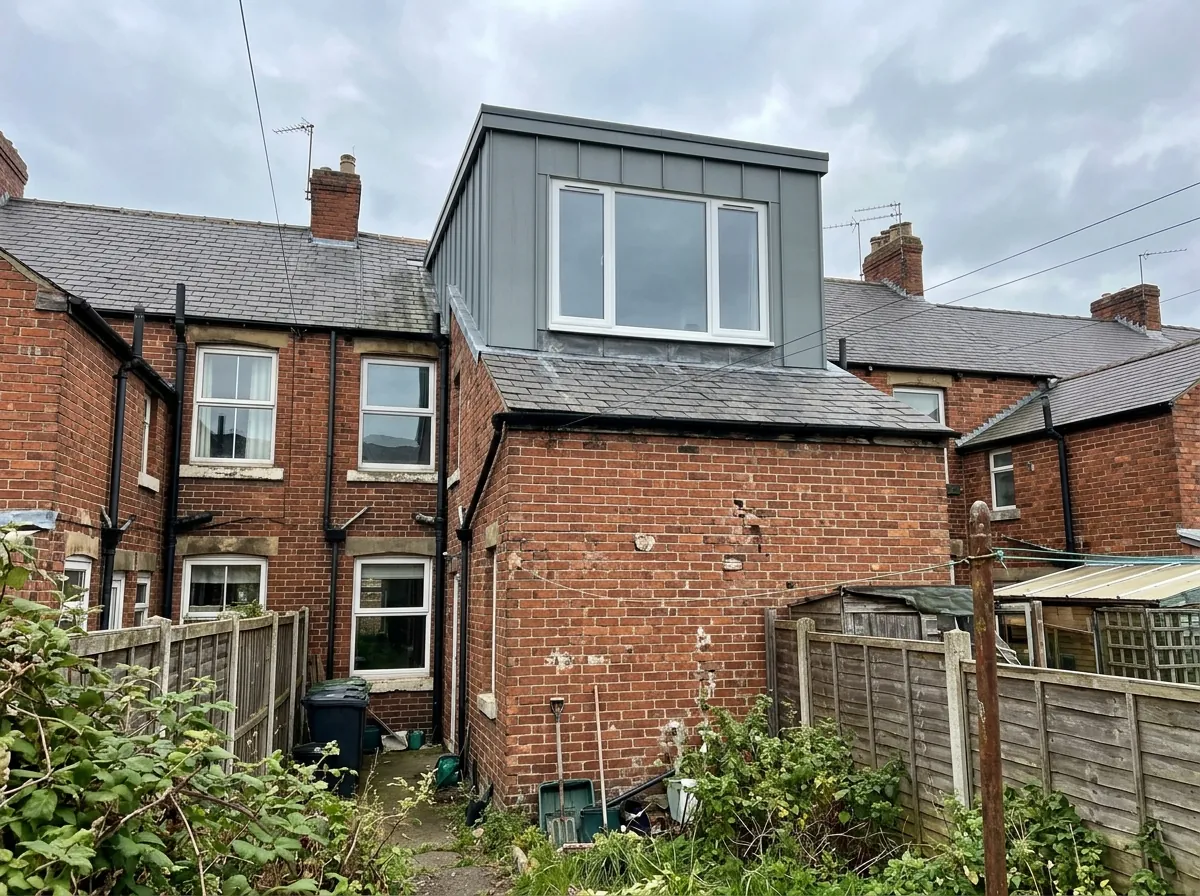
The standard scheme on an upper Tyneside flat is a rear dormer over the back bedroom and scullery outshot, with the new staircase stacked above the existing one. The existing stair already rises from the flat's own front door, so continuing the flight upward in the same stairwell keeps the landing compact and protects the bedrooms below. Done well, the new floor takes a double bedroom with an ensuite shower room, with the dormer face sitting below the ridge and invisible from the street.
Structurally, the new floor spans between the party walls as an independent structure, so the existing lath and plaster ceiling below carries no new load. The floor between the two flats is a compartment floor, and the work has to maintain and usually improve its fire and sound separation.
Access is the quirk that catches people out. With no side return, scaffolding rises from the rear yard and materials travel along the back lane. Yards are small and sometimes split, so the scaffold often stands partly on the downstairs neighbour's half, agreed through the party wall process or a simple licence, and skips need a council permit for the lane.
Fire regulation is the other big difference. A loft room makes the upper flat a two-storey home with a floor more than 4.5 metres above ground, so Building Regulations require a protected stair enclosure down to the flat's own front door, fire doors and mains-wired interlinked smoke alarms on every storey. The layout suits this naturally, because the stair already discharges to its own street-level exit rather than a shared lobby.
What a Tyneside flat loft conversion costs in 2026
North East build pricing sits around 12 percent below the UK average, and Tyneside flat work then carries its own premium on top. For the same floor area, expect a Tyneside flat dormer to price 10 to 15 percent above the equivalent job on a standard terrace, reflecting the party wall workload, the independent floor structure, the access constraints and the planning application. Realistic 2026 figures:
- Rooflight conversion on an upper flat: £22,000 to £33,000
- Rear dormer with one double bedroom: £38,000 to £48,000
- Rear dormer with bedroom and ensuite: £44,000 to £55,000
On top of the build price, budget for:
- Planning application fee: £548
- Building Regulations fees: £500 to £900
- Structural engineer: £600 to £1,200
- Legal work on the lease, licence for alterations or deed of variation: £1,500 to £3,000, plus any payment agreed with your neighbour where the void sits outside your demise
- Party Wall surveyor: £900 to £1,500 per award where a neighbour dissents
A sensible all-in figure for a dormer scheme is £42,000 to £60,000 depending on spec and how smoothly the legal step runs. Allow two to four months for title work and neighbour consent, which can run alongside design and the eight-week planning determination, then 8 to 12 weeks on site. Most projects complete five to eight months after the first survey.
What the conversion is worth: from flat to family home
The value case on a Tyneside flat is unusually strong, because the conversion changes what the property is. A two-bedroom single-storey flat becomes a three or four bedroom home over two floors, which agents in NE6 and along the coast typically market as a maisonette. That moves it out of the first-time buyer and investor pool and into the searches of young families priced out of the local terraced houses. Loft conversions across the UK typically add 15 to 20 percent to value; on an upper Tyneside flat the change in category can push the return beyond the usual band, particularly in Heaton and the coastal streets of Whitley Bay and North Shields where family demand runs hottest.
Landlords should read the planning position carefully. Extra bedrooms for a single household are covered by the ordinary planning application. Letting the enlarged flat to three or more unrelated sharers is a change of use to a small HMO, and Newcastle has Article 4 directions covering Jesmond and Heaton, parts of Sandyford, South Gosforth and Ilford Road, High West Jesmond and North Jesmond, and the St Gabriel's estate, which remove the usual freedom to switch from family dwelling to HMO without permission. A conversion for your own household or a family tenant raises none of this; an HMO plan needs its own planning advice and, in Newcastle, attention to licensing.
How we handle Tyneside flat conversions
UK Loft Conversion is a nationwide loft conversion specialist, and our North East team knows how these pairs are built. The process:
- Free home survey, including a headroom check and a first read of your title and lease position
- Free written quote after the home visit, itemised by stage so you can see exactly what is included, with the Tyneside-specific costs shown up front rather than surfacing mid-project
- Planning application prepared and submitted on your behalf, with drawings shaped to Newcastle, North Tyneside or Gateshead design guidance
- Party wall notices and neighbour consent coordinated with the legal work, so the sequencing is handled in the right order
- A 10 year workmanship warranty on completion
We will also tell you early if the project does not stack up. A low ridge or an unwilling freeholder is better discovered in week one than after months of fees. Most Tyneside flats pass all three gates, and the ones that do gain more from a loft conversion than almost any other property type in the North East.
Before you book
Frequently asked questions
Do Tyneside flats have permitted development rights?
No. Permitted development rights for roof enlargements under Class B of the General Permitted Development Order apply only to dwellinghouses, and the Order's definition excludes flats. Newcastle City Council's Householder Design Guide confirms that any external alterations to flats, including Tyneside flats, require planning permission.
Do I need planning permission to convert the loft of a Tyneside flat?
Yes, always. Every Tyneside flat loft conversion needs a full planning application, whether the scheme is a rear dormer or a couple of rooflights. The fee for altering a single dwelling is £548 from April 2026, and determination usually takes around eight weeks.
Who owns the loft space in a Tyneside flat?
Under the standard criss-cross lease the upper flat's demise usually includes the roof and roof void. Some leases stop at ceiling level, so order official copies of both titles from HM Land Registry and have a conveyancer confirm the position before spending anything on design.
Do I need my downstairs neighbour's permission to convert?
Almost always. Your downstairs neighbour is normally your freeholder under the criss-cross arrangement, and the lease will usually restrict structural alterations without their written consent, given through a licence for alterations or a deed of variation. They also receive notice under the Party Wall Act.
How much does a Tyneside flat loft conversion cost in 2026?
A rear dormer on an upper Tyneside flat typically costs £38,000 to £55,000 fitted, roughly 10 to 15 percent above the same dormer on a standard terrace, with rooflight schemes from £22,000. Add around £3,500 to £7,000 for planning, Building Regulations, structural engineering, legal consent and party wall costs.
How long does a Tyneside flat loft conversion take?
Five to eight months end to end. Title checks and neighbour consent take two to four months and can run alongside design and the eight-week planning determination. The build itself takes 8 to 12 weeks on site, and the flat remains liveable through most of it.
Can I put a dormer on the front of a Tyneside flat?
Rarely. Newcastle's Householder Design Guide warns that flat-roofed dormers on front elevations will not normally be acceptable, and planners protect the front roofline strongly on terraced streets. Nearly all approved Tyneside flat schemes use a rear dormer or rear rooflights and leave the street elevation untouched.
Does converting the loft turn my Tyneside flat into an HMO?
No. Adding bedrooms for a single household is an alteration and needs only the planning application every flat conversion requires. Letting the enlarged flat to three or more unrelated sharers is a change of use to an HMO, which needs separate permission in Newcastle's Article 4 areas such as Jesmond and Heaton, plus a licence.
How much value does a loft conversion add to a Tyneside flat?
UK loft conversions typically add 15 to 20 percent to value. On an upper Tyneside flat the effect is often stronger, because a two-bed flat becomes a three or four bed maisonette and enters the family-buyer market, which runs hottest in Heaton, Whitley Bay and North Shields.
Can I do a loft conversion in a leasehold flat?
Often yes, but the lease decides. First check whether the loft space is inside your demise (the property your lease actually grants you). In many Tyneside flats the roof void belongs to the upper flat, but some leases keep it with the freeholder. If the space is not demised to you, you need to buy it or have it added to your lease before any work. You will normally also need the freeholder's consent in the form of a licence to alter, and because flats have no permitted development rights, a full planning application (£548) is required on top. A conveyancing solicitor can confirm the position from your title documents in an hour or two, and it is the first thing we check on any flat enquiry.
Related pages
- Cities/Newcastle →
- Cities/Newcastle/Heaton →
- Cities/Newcastle/Jesmond →
- Cities/Newcastle/Whitley Bay →
- Cities/Newcastle/Tynemouth →
- Cities/Newcastle/North Shields →
- Cities/Newcastle/Gateshead →
- Cities/Newcastle/Dormer →
- Cities/Newcastle/Velux →
- Cities/Newcastle/Cost →
- Cities/Newcastle/Planning Permission →
- Loft Conversion Cost →
- Loft Conversion Planning Permission →
- Types Of Dormer →
Ready for a written quote?
Free home survey, a written quote itemised by stage, and a 10 year workmanship warranty.