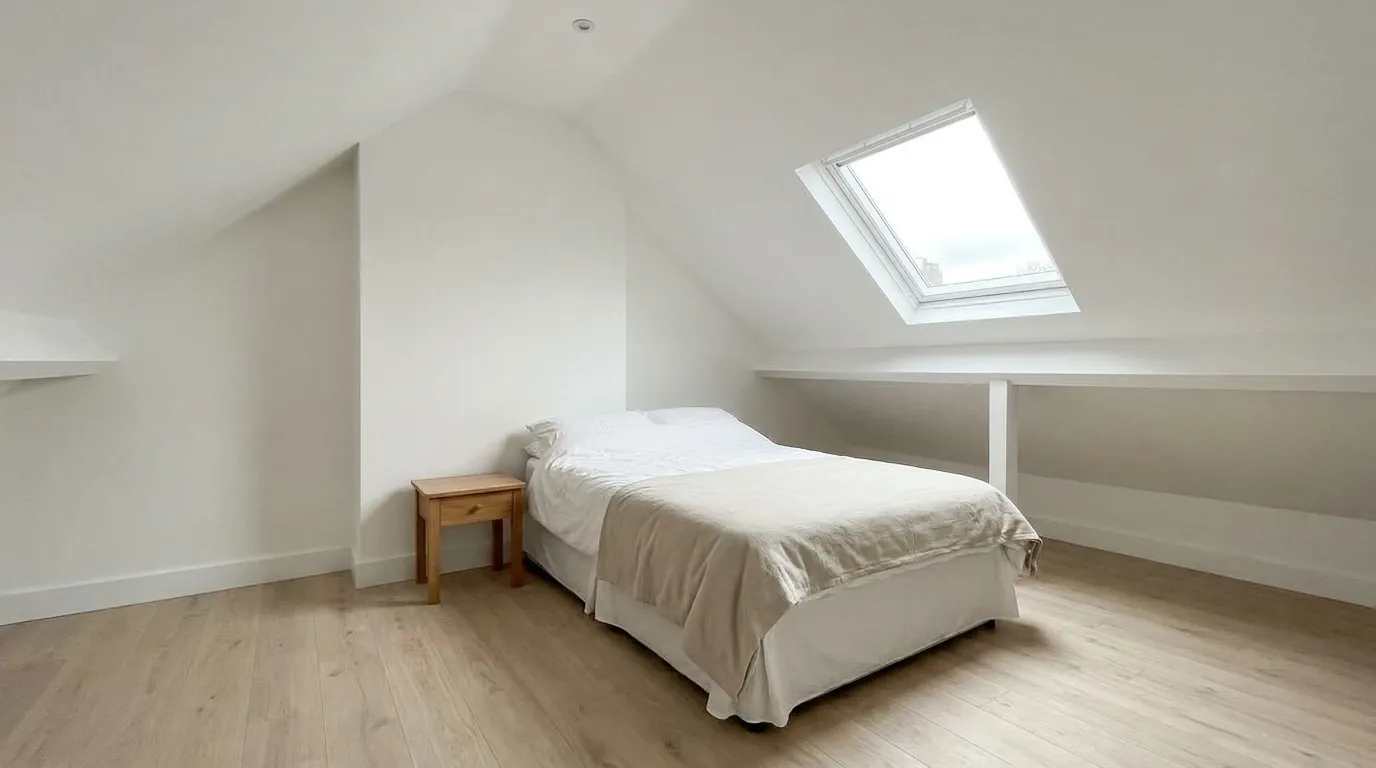
Headline summary: UK loft conversion costs in 2026
Most UK loft conversions in 2026 land somewhere between 20,000 pounds and 85,000 pounds fitted, with the national average for a standard rear dormer sitting at around 45,000 pounds to 50,000 pounds. The cheapest option is a Velux (rooflight) conversion, which leaves the roof shape alone. The most expensive is a mansard, which rebuilds the whole rear roof slope at 70 degrees and adds the most floor area.
Quick reference, fitted prices including VAT, UK 2026:
| Conversion type | Typical range | National average | Build time |
|---|---|---|---|
| Velux / rooflight | 20,000 - 35,000 | 27,500 | 4-6 weeks |
| Rear dormer | 35,000 - 60,000 | 47,500 | 8-12 weeks |
| L-shaped dormer | 45,000 - 65,000 | 55,000 | 10-14 weeks |
| Hip-to-gable | 45,000 - 65,000 | 55,000 | 10-14 weeks |
| Mansard | 55,000 - 85,000 | 67,500 | 12-16 weeks |
| Mansard (inner London) | 100,000+ | 110,000 | 14-18 weeks |
These numbers assume a single bedroom plus en-suite finish to a normal residential standard, mid-range fittings, normal access and no significant party wall complications. Strip out the en-suite and you save roughly 6,000 to 9,000 pounds. Push the spec to luxury (custom joinery, underfloor heating, designer sanitaryware) and you add 10,000 to 20,000 pounds.
Sources for the headline ranges: Checkatrade Loft Conversion Cost Guide 2026, MyJobQuote UK Prices 2026, TradeMatch UK 2026 Pricing, MyBuildAlly Q1 2026 BCIS analysis, Which?/BCIS 2025.
Get your number in 20 seconds
Every table on this page is a range, because every roof is different. For a faster read on your own project, set the four options below and see the typical fitted band for your kind of conversion.
The band is indicative. The written quote that follows the free home survey is itemised by stage so you can see exactly what is included.
Attic conversion cost (the same job by another name)
If you have been searching for attic conversion costs rather than loft conversion costs, you are looking for exactly the same job. An attic conversion and a loft conversion are the identical piece of building work: turning the unused roof space above your ceiling into a habitable room. The price bands, the build types and the timelines on this page all apply without change.
The word you use tends to depend on where you live and who you are talking to. Homeowners across the North of England and in Scotland more often say attic. In the South and among builders and architects nationwide, the trade word is loft. Estate agents use both. There is no difference in the work, the Building Regulations, the planning rules or the cost.
So when a Newcastle or Edinburgh homeowner asks for an attic conversion price, the honest answer is the same set of figures the rest of this guide uses:
- Attic (Velux) conversion: 20,000 to 35,000 pounds. Rooflight windows go into the existing roof and the shape stays as it is.
- Attic (dormer) conversion: 35,000 to 60,000 pounds. A box built out from the rear slope for full standing height. The most common attic conversion in the UK.
- Attic (mansard) conversion: 55,000 to 85,000 pounds. A full rebuild of the roof slope, most floor area, usually needs planning permission.
Attic conversion prices in the North East and Scotland tend to sit at the lower end of each band, because labour rates are lower than in London and the South East. A standard dormer attic conversion in Newcastle, Sunderland or Gateshead typically comes in around 40,000 to 42,000 pounds, against 52,000 pounds for the same room in outer London. The regional table further down this page sets out the full picture.
The short version: attic conversion cost and loft conversion cost are the same number. Whichever word you searched for, the rest of this guide gives you the real 2026 figures.
Loft conversion cost by type
The conversion type is the single biggest cost driver, ahead of region and ahead of size. Here is what each one actually costs in 2026 and why.
Velux (rooflight) loft conversion - 20,000 to 35,000 pounds
A Velux conversion keeps the existing roof structure intact. The builder strengthens the floor with steel or timber joists, runs a new staircase up, insulates between and under the rafters, and cuts in two to four rooflight windows. There is no external structure to build, no scaffold platform extension and no party wall agreement in most cases.
Sub-type variants:
- Two-window basic: 20,000 to 25,000 pounds. Single room, no en-suite.
- Four-window standard: 26,000 to 30,000 pounds. Bedroom plus shower room.
- Premium fit-out with electric blinds and en-suite: 30,000 to 35,000 pounds.
Why it costs what it costs: the cost floor is set by the staircase (3,000 to 5,000 pounds installed), the steels for the new floor (3,000 to 6,000 pounds), insulation (2,500 to 4,000 pounds) and the Velux windows themselves (around 1,000 pounds each fitted, see MyJobQuote). Labour is the other half. You need decent head height (2.2m at the apex, ideally 2.4m) for it to be worth doing.
Rear dormer loft conversion - 35,000 to 60,000 pounds
The rear dormer is the workhorse of UK loft conversions. The builder takes off the back roof slope, builds a flat-roof box that sits proud of the existing roofline, and gives you full standing headroom across most of the floor plate. Typical floor area is 18 to 25 m squared usable.
Sub-type variants:
- Box dormer (flat roof): 35,000 to 50,000 pounds. The standard option.
- Pitched-roof dormer: 42,000 to 58,000 pounds. Better looking, more roof work.
- Full-width dormer: 45,000 to 60,000 pounds. Maximum floor area, often needs planning approval rather than permitted development.
Why it costs what it costs: you are now building a structure (timber frame, EPDM rubber roof, zinc or render finish on the cheeks, dormer windows). That structure plus its fit-out is roughly 8,000 to 15,000 pounds on top of the base Velux cost. You also need more scaffolding, more building control inspections and usually a party wall agreement if you are terraced or semi-detached.
L-shaped dormer loft conversion - 45,000 to 65,000 pounds
The L-shaped is the Victorian terrace special. It combines a main rear dormer with a smaller side dormer over the outrigger (the kitchen or bathroom extension that sticks out the back). You get two bedrooms plus a bathroom out of one project on a property that normally only has loft space for one.
Sub-type variants:
- Two-bed L-shape standard: 45,000 to 55,000 pounds.
- Two-bed plus en-suite: 52,000 to 62,000 pounds.
- Premium specification: 60,000 to 65,000 pounds plus.
Why it costs what it costs: you are essentially building two dormers connected by a corner, with more complex roofing, an extra steel beam where the two structures meet and more floor area to fit out. Most popular in London, Manchester, Birmingham, Leeds and Newcastle terraces.
Hip-to-gable loft conversion - 45,000 to 65,000 pounds
Used on end-of-terrace and semi-detached houses with a hipped (sloped) end roof. The builder removes the hip, builds the gable end wall up vertically and then either fits Velux windows or adds a rear dormer on top. The vertical gable wall transforms the usable floor area.
Sub-type variants:
- Hip-to-gable only with Velux: 45,000 to 52,000 pounds.
- Hip-to-gable plus rear dormer: 55,000 to 65,000 pounds. Most common combination.
- Double hip-to-gable (detached): 60,000 to 75,000 pounds.
Why it costs what it costs: rebuilding the gable end in blockwork with proper tying and bracing is real structural work. Add the new roof tiles to match, lead flashings, scaffold for both elevations and you are 10,000 to 15,000 pounds above a standard rear dormer.
Mansard loft conversion - 55,000 to 85,000 pounds (London 100,000+)
The mansard rebuilds the entire rear roof slope at a 70 to 72 degree angle, with the new wall lined in matching brick or slate. It gives you the largest floor area of any conversion type and visually it can look like the property always had a top storey. Common in London period terraces, Bath, Edinburgh New Town and other conservation-sensitive areas.
Sub-type variants:
- Single-side mansard: 55,000 to 70,000 pounds.
- Double mansard (front and rear): 75,000 to 90,000 pounds.
- Inner London period property: 90,000 to 130,000 pounds. Higher labour rates, conservation specification, brick to match the existing facade.
Why it costs what it costs: a mansard is a roof replacement, not an extension. Almost every mansard needs full planning permission (it is not covered by permitted development), the structural calcs are heavier, the brick or slate finish costs significantly more than render or zinc, and the build runs 12 to 16 weeks.
For type-by-type sub-pages see /dormer-loft-conversion/, /mansard-loft-conversion/, /hip-to-gable-loft-conversion/ and /velux-loft-conversion/.
For a visual breakdown of every dormer shape and what each one costs, see the types of dormer guide.
Loft conversion cost by region (UK 2026)
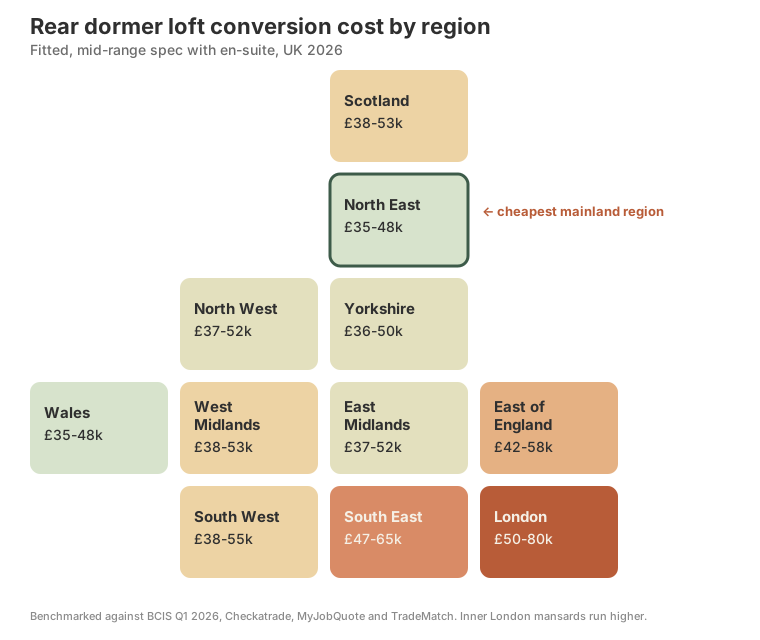
Where you live can swing the price by 30,000 pounds on the same job. London labour is roughly 30 to 40 percent more expensive than the North East. The table below is benchmarked against a standard rear dormer fitted to a normal residential standard, with mid-range fittings and en-suite included. Data cross-referenced from BCIS regional benchmarks (Q1 2026), Checkatrade, MyJobQuote and TradeMatch.
| Region | Rear dormer range | vs UK average | Notes |
|---|---|---|---|
| London (inner) | 55,000 - 80,000 | +30 to 45% | Conservation areas common, mansard often required |
| London (outer) | 50,000 - 70,000 | +20 to 35% | Standard dormer still typical |
| South East | 47,000 - 65,000 | +15 to 25% | Surrey, Kent, Sussex commuter belt |
| East of England | 42,000 - 58,000 | +5 to 15% | Cambridge premium, rest closer to average |
| South West | 38,000 - 55,000 | -5 to +10% | Bristol slightly higher than rural |
| West Midlands | 38,000 - 53,000 | -5 to +5% | Birmingham at average, rest below |
| East Midlands | 37,000 - 52,000 | -7 to +3% | Nottingham, Derby, Leicester |
| North West | 37,000 - 52,000 | -7 to +3% | Manchester and Liverpool slightly above |
| Yorkshire | 36,000 - 50,000 | -10 to 0% | Leeds, Sheffield, York |
| North East | 35,000 - 48,000 | -12 to -5% | Newcastle, Sunderland, Durham - the cheapest mainland region |
| Wales | 35,000 - 48,000 | -12 to -5% | Cardiff slightly higher than valleys |
| Scotland | 38,000 - 53,000 | -5 to +5% | Edinburgh premium, Glasgow at average |
The North East is consistently the cheapest mainland region in 2026. A standard rear dormer that lands at 52,000 pounds in outer London typically lands at 40,000 to 42,000 pounds in Newcastle, Sunderland or Gateshead. Labour rates are lower, material delivery is the same, and the local trade is competitive. If you are in Newcastle, our area pages cover specific neighbourhoods: /cities/newcastle/jesmond/, /cities/newcastle/gosforth/, /cities/newcastle/heaton/, /cities/newcastle/tynemouth/ and /cities/newcastle/whitley-bay/. A full city breakdown sits at /cities/newcastle/cost/.
For other major cities see /cities/london/, /cities/manchester/, /cities/birmingham/ and /cities/leeds/.
Loft conversion cost by property type
The shape and structure of your home dictate what type of conversion is realistic and what it will cost. A terrace and a detached house are different propositions even at the same square metres.
Terraced house
Typical conversion: rear dormer or L-shaped dormer. Typical cost: 35,000 to 60,000 pounds.
Terraces share at least one party wall, so you almost always need a Party Wall Award (legal cost 700 to 1,500 pounds per neighbour). Access is from the rear only, which can add 1,000 to 3,000 pounds to scaffolding if there is no side return. The flip side: the room shape is predictable and the dormer detailing is well understood by local trades, so quotes tend to be tighter.
Victorian and Edwardian terraces with an outrigger are perfect candidates for an L-shaped dormer, giving you two rooms out of one project.
Semi-detached house
Typical conversion: hip-to-gable plus rear dormer, or rear dormer only. Typical cost: 45,000 to 65,000 pounds.
Most UK semis have a hipped roof on the gable end. Building that hip up to a vertical gable transforms the loft from a triangular crawl space into a proper room. A hip-to-gable plus rear dormer gives you the floor area you need for a bedroom and en-suite. One party wall means one party wall agreement.
Detached house
Typical conversion: hip-to-gable both sides, or large rear dormer. Typical cost: 45,000 to 75,000 pounds.
No party wall issues, scaffold access on all sides, more permitted development allowance (50 cubic metres rather than 40). The catch is the size: detached lofts are usually bigger, which means more steels, more insulation and more fit-out. Bungalow conversions sit in this bracket and typically come in at 60,000 to 90,000 pounds because you are essentially adding a whole new floor (Checkatrade puts the bungalow average at 75,000 pounds, see source above).
Bungalow
Typical conversion: full first-floor conversion with dormers front and rear. Typical cost: 60,000 to 90,000 pounds.
Bungalows give you the biggest floor area uplift of any property type, often doubling the usable space. The trade-off is that you are essentially building a new storey: more steelwork, more roofing, more fit-out, and you almost always need planning permission rather than relying on permitted development. Full detail sits at /bungalow-loft-conversion/.
Period and listed property
If the property is listed or sits in a conservation area, you can usually rule out permitted development. A mansard becomes the typical option, with conservation-grade brick or slate to match the existing facade. Budget 65,000 to 130,000 pounds depending on listing grade and location. See /blog/conservation-area-rules-uk/ for the planning detail.
Where the money actually goes: cost breakdown for a typical rear dormer
We took the budget for a standard 47,500 pound rear dormer on a three-bed semi in the Midlands and broke it down line by line. Use this to sanity-check any quote you receive.
| Line item | Typical cost | Share of total |
|---|---|---|
| Structural steelwork (RSJs, floor joists, padstones) | 4,500 | 9.5% |
| Dormer construction (frame, roof, cheeks, EPDM) | 8,500 | 18% |
| Staircase (oak or painted softwood, balustrade) | 3,500 | 7.5% |
| Windows (two dormer + one Velux on the roof slope) | 2,800 | 6% |
| Insulation (between rafters, party walls, floor) | 2,400 | 5% |
| First fix (plumbing, electrics, heating runs) | 3,500 | 7.5% |
| Plasterboard and plastering | 3,200 | 7% |
| En-suite (shower, WC, basin, tiling, extractor) | 4,800 | 10% |
| Second fix and decoration (paint, flooring, skirting, ironmongery) | 4,200 | 9% |
| Scaffolding (8 to 12 weeks hire) | 2,800 | 6% |
| Architectural drawings and structural calcs | 1,500 | 3% |
| Building Regulations application and inspections | 750 | 1.5% |
| Party wall surveyor (one neighbour) | 1,200 | 2.5% |
| Contingency (allowed for in quote) | 3,800 | 8% |
| Total | 47,450 | 100% |
Labour vs materials split: roughly 45 percent labour, 35 percent materials, 10 percent fixtures and fittings, 5 percent planning and statutory, 5 percent contingency. This tracks the BCIS split that Which? publishes from the Building Cost Information Service data.
Where quotes lie to you: if a builder gives you a number more than 15 percent below the rest of the market, the most common omission is the en-suite, the steelwork allowance, or the scaffolding. Always insist on an itemised written quote, which is what we arrange for you as standard.
Per square metre rates by type
Loft conversion costs are best understood as fitted prices because the fixed costs (staircase, steels, planning, scaffolding) dominate small projects. That said, per-m-squared rates are useful for comparing one quote to another when the floor areas differ.
2026 UK per-m-squared rates, fitted with normal residential specification:
| Conversion type | Per m squared (low) | Per m squared (typical) | Per m squared (high) |
|---|---|---|---|
| Velux | 900 | 1,100 | 1,400 |
| Rear dormer | 1,500 | 1,750 | 2,100 |
| L-shaped dormer | 1,700 | 1,900 | 2,200 |
| Hip-to-gable | 1,800 | 2,050 | 2,400 |
| Mansard | 2,000 | 2,250 | 2,700 |
These line up with Checkatrade's published rates (1,670 per m squared dormer, 2,170 mansard) and MyJobQuote's typical range of 1,200 to 1,800. London adds 25 to 40 percent on top.
Important caveat: anyone quoting you on pure per-m-squared without seeing the property is guessing. Two identical sized lofts can differ by 8,000 pounds because one needs a hip-to-gable rebuild and the other just needs Velux windows. The per-m-squared number works as a sanity check rather than a quoting tool.
Hidden costs to budget for
The headline quote is rarely the final number. Here are the costs that catch homeowners out, in rough order of how often they show up.
Building Regulations application fees: 500 to 900 pounds. This is separate from any planning application. Every loft conversion needs Building Regs approval regardless of whether you need planning permission. Local authority fees vary by region.
Planning application (if needed): 548 pounds for a householder application in England (fee from 1 April 2026). Most dormers and Velux conversions on houses fall under permitted development, but conservation areas, Article 4 directions, flats and mansards always need planning. If you want written confirmation that your job is permitted development, a Lawful Development Certificate for a proposed use costs 274 pounds (half the householder fee). Note that the Planning Portal adds a processing fee of around 91 pounds if you apply online. Allow eight to twelve weeks for a decision once the application is valid.
Party Wall surveyor: 700 to 1,500 pounds per neighbour. Required for terraces and semis where the work affects a shared wall. If a neighbour disputes, you can be looking at 2,000 to 4,000 pounds per side.
Architectural drawings and structural calculations: 1,200 to 2,500 pounds. Sometimes bundled into the builder's quote, sometimes separate. For mansards and listed buildings, add a heritage consultant if required.
Asbestos survey: 300 to 600 pounds. Only relevant in properties built before 2000 with original artex ceilings or insulation. Removal if found is 800 to 2,000 pounds.
Bat or wildlife survey: 400 to 900 pounds. Required if there is any evidence of bat roosting (legally protected). Adds time as well as cost: surveys can only be done May to September.
Electrical consumer unit upgrade: 700 to 1,500 pounds. Older homes often need a new consumer unit to take the extra load.
Boiler upgrade: 2,500 to 4,500 pounds. If your existing boiler cannot heat the new room, you may need a system upgrade or a separate heating zone.
Rewiring nearby circuits to current Part P standards: 800 to 2,500 pounds. When the electrician opens up ceilings on the floor below to run cables, anything non-compliant gets flagged.
Decoration of the floor below: 1,500 to 3,500 pounds. The new staircase opening tears into the ceiling of the floor below. Painting and snagging there is rarely in the loft quote.
Furniture and fittings: 3,000 to 12,000 pounds. Beds, wardrobes, blinds, lights, curtains. Not part of any builder's quote but a real cost.
Contingency: 10 percent of contract value, minimum. Which? recommends no less than 10 percent. We agree. Old houses hide surprises in the roof structure that nobody can see until the slates come off.
For the full statutory picture see /loft-conversion-building-regulations/.
Loft conversion vs moving house: when does it pay off?
The maths on building versus moving has shifted hard in favour of building since stamp duty thresholds tightened and average UK house prices climbed past 290,000 pounds.
Worked example: a 350,000 pound three-bed semi in the Midlands. Family wants a fourth bedroom and a second bathroom.
Option A - move to a four-bed at 430,000 pounds:
- Stamp duty: 9,000 pounds
- Estate agent fees on the sale: 3,500 pounds
- Conveyancing both sides: 2,400 pounds
- Surveys and searches: 1,000 pounds
- Removals: 1,500 pounds
- Mortgage product fees: 1,000 pounds
- Carpets, curtains, immediate updates to the new house: 5,000 pounds
- Top-up borrowing on the difference: 80,000 pounds plus all the above transaction costs
- Total acquisition cost over the asking price gap: roughly 23,400 pounds in friction.
Option B - L-shaped dormer at 55,000 pounds:
- All-in build cost: 55,000 pounds
- Likely uplift to property value: 15 to 25 percent of 350,000 = 52,500 to 87,500 pounds
- Net position after the build: minus 2,500 pounds to plus 32,500 pounds (i.e. break-even to 32k uplift, before considering the value of staying put)
- No stamp duty, no estate agents, no schools change, no moving.
On that example, building beats moving every time. The case flips only when the property is already at the top of its street's value ceiling - in those situations a conversion may not recover its cost on sale. For a detailed look at the value uplift maths see /blog/loft-conversion-roi-uk-2026/.
Rules of thumb for ROI:
- 15 to 25 percent uplift on existing property value is the typical range across the UK.
- London and the South East consistently recover the full cost of the build, often more.
- North East, Yorkshire, Wales and parts of Scotland may not fully recover a top-spec build on sale, but you still get the space to live in for years before you sell.
- Two-bed becomes three-bed: biggest jump in marketability. Three becomes four: still strong. Four becomes five: diminishing returns.
- En-suite added: roughly half the en-suite cost back in valuation. Worth doing for liveability, less so for pure resale.
How most people pay for it
Loft conversions are typically funded from one of three sources: savings, a mortgage further advance against the equity in the property, or a personal home improvement loan.
Savings. The cleanest option. No interest, no application, no monthly outflow once the build is done. Most of the homeowners we survey fund the bulk of the project from cash and use the build as a way to put existing equity to work.
Mortgage further advance. Going back to your existing mortgage lender to borrow more against the property, typically on the same rate or a slightly different product. Application takes two to six weeks. You need a recent valuation. Best suited if you have 30 percent plus equity already.
Remortgaging. Moving to a new lender and increasing the loan in the process. Worth it if your current rate is uncompetitive. Builds in additional legal and valuation costs (around 1,500 pounds).
Personal loan. Unsecured borrowing, faster to arrange, smaller amounts only (most lenders cap personal loans at 25,000 to 50,000 pounds). Quicker but typically more expensive per month than secured borrowing.
A note on staging payments. Most reputable loft conversion firms work to a stage payment schedule: deposit on signing (usually 5 to 10 percent), then progress payments at completion of structural, weathertight, first fix, second fix and final sign-off. Never pay the full balance up front. If a builder asks for more than 25 percent before steels are in, walk away.
Build duration: how long does it take?
Build time is closely tied to type. Here is what to expect on site from skip-arrival to handover.
| Conversion type | On-site duration | Total timeline including planning |
|---|---|---|
| Velux | 4 to 6 weeks | 8 to 12 weeks |
| Rear dormer | 8 to 12 weeks | 14 to 22 weeks |
| L-shaped dormer | 10 to 14 weeks | 16 to 26 weeks |
| Hip-to-gable | 10 to 14 weeks | 18 to 28 weeks |
| Mansard | 12 to 16 weeks | 22 to 34 weeks |
The planning leg is the variable. Permitted development jobs can start within four to six weeks of signing if drawings are already done. Full planning takes eight to twelve weeks for a decision once the council has validated the application, plus another two to four weeks for Building Control to review structural drawings. Add it all up and a mansard in a conservation area can easily run nine months end-to-end. For the full breakdown see /blog/how-long-does-loft-conversion-take/.
Most importantly: you can stay in the house for almost the entire build. Scaffolding goes up, the roof opens for around two days under temporary cover, and the staircase opening is the only week where dust upstairs is unavoidable. We have done hundreds of conversions where the homeowner barely changed their routine. If you want to know how the whole job runs from first survey to handover, see /how-to-convert-a-loft/.
Common mistakes that cost extra money
After running quotes nationwide, we see the same expensive mistakes again and again. Avoiding these saves typical homeowners 5,000 to 15,000 pounds on a project.
Skipping the survey. Builders who quote off photos or a quick chat almost always under-quote, then bill for variations. Insist on a free home survey with measurements taken on site.
Ignoring head height. If the apex of your existing roof is below 2.2 metres, a Velux conversion will not give you usable standing room. A dormer becomes the only realistic option, which moves the price up by 20,000 pounds. Better to know on day one.
Assuming permitted development covers everything. It usually does, but Article 4 directions, conservation areas, listed buildings and flats are all exceptions. A 548 pound planning application beats the demolition order you get for building without permission.
Specifying the en-suite late. Plumbing runs and structural opening positions change if you add a bathroom mid-build. Decide early, lock the layout, save 2,000 to 4,000 pounds in rework.
Choosing the cheapest quote. A 38,000 pound dormer that should cost 47,000 pounds will hit you for 12,000 pounds in variations and end up at 50,000 pounds for a worse spec. Look for the middle of the range with a fully itemised written quote and a 10 year workmanship warranty.
Skipping the contingency. Old roofs hide surprises (rotten purlins, undersized rafters, asbestos artex, no sarking felt). 10 percent contingency is not optional, it is engineering reality.
Not budgeting for the floor below. Staircases tear up ceilings. Decoration, sometimes a small bedroom remodel, often a new landing carpet. Allow 2,000 to 4,000 pounds.
More failure modes covered in /blog/loft-conversion-mistakes-to-avoid/.
What you get with UK Loft Conversion
We are a UK-wide loft conversion specialist working across England, Wales and Scotland. Our standard package includes:
- Free home survey with full measurements and feasibility report.
- Written quote itemised by stage so you can see exactly what is included.
- 10 year workmanship warranty on all steelwork, roof structure and dormer construction.
- Full project management from drawings through Building Control sign-off. One point of contact start to finish.
- Stage payment schedule. Pay as the build progresses.
- All trades certified with current insurance, CSCS cards and Gas Safe / NICEIC certification where relevant.
- Building Regs handled in-house. We submit drawings, book inspections and deal with the local authority on your behalf.
If you want a written quote on your own roof, the fastest route is to request a free home survey. We will measure up, confirm what type of conversion suits the property, talk you through the spec and follow up with a written quote itemised by stage. There is no obligation to proceed.
Before you book
Frequently asked questions
What is the average cost of a loft conversion in the UK?
The average UK loft conversion in 2026 costs around 45,000 to 50,000 pounds, which is the typical price for a standard rear dormer, the most common type. Across all types the range runs from about 20,000 pounds for a basic Velux conversion to 85,000 pounds for a mansard, and over 100,000 pounds for a mansard on an inner-London period property. Most standard jobs land in the 30,000 to 70,000 pound band.
How much does a loft conversion cost in 2026?
In 2026 a UK loft conversion costs between 20,000 and 85,000 pounds fitted, including VAT. A Velux (rooflight) conversion is 20,000 to 35,000 pounds, a rear dormer is 35,000 to 60,000 pounds, a hip-to-gable or L-shaped dormer is 45,000 to 65,000 pounds, and a mansard is 55,000 to 85,000 pounds. Inner-London mansards run past 100,000 pounds. Prices rose modestly through 2025 and 2026 with materials and labour, so treat 2024 figures as low.
How much should I expect to pay for a loft conversion?
Budget around 45,000 to 50,000 pounds for a typical bedroom-plus-en-suite rear dormer, which is what most families end up building. Go simpler with a Velux and no en-suite and you can be under 25,000 pounds. Add a hip-to-gable rebuild, a bigger footprint or a mansard and you move up towards 65,000 to 85,000 pounds. Where you live matters: the North East and Scotland sit at the lower end, London the higher. Always get a written quote after a site survey rather than working off a headline average.
Can you do a loft conversion for 20k?
Yes. Twenty thousand pounds buys a basic two-window Velux (rooflight) conversion, provided your loft already has enough head height (2.2 metres at the apex minimum) and the roof shape does not need changing. For that money you get the floor strengthened with steels, a new staircase, insulation, plasterboard, two rooflight windows and decoration, giving you one usable room. It does not include an en-suite or any change to the roofline. If your loft needs a dormer to get standing height, 20k will not cover it and you should budget from 35,000 pounds.
Can you do a loft conversion for 10k?
Realistically no, not for a habitable room that meets Building Regulations. Ten thousand pounds is roughly what the staircase and the structural steelwork alone cost on a real conversion. It does not stretch to insulation, fire-rated plasterboard, wiring, windows, Building Control sign-off and decoration, all of which are legally required for the space to count as a bedroom. What 10k can cover is loft boarding and a loft ladder for storage, or a very basic non-Building-Regs hobby space that you cannot legally market as an extra bedroom. Any quote at 10,000 pounds for a full conversion is either missing major line items or is not a compliant build. A genuine habitable conversion starts around 20,000 pounds for a Velux.
What is cheaper, a loft conversion or an extension?
A loft conversion is usually cheaper per room than a ground-floor extension. A single-storey rear extension in the UK typically costs 40,000 to 75,000 pounds and a double-storey extension 65,000 to 120,000 pounds, while a comparable loft conversion runs 20,000 to 60,000 pounds for most types. The loft also keeps your garden, whereas an extension eats into it. The main reason to choose an extension instead is if your loft lacks the head height to convert, or if you specifically need to enlarge a ground-floor kitchen or living space rather than add bedrooms upstairs.
Is a loft conversion worth the money?
For most UK homeowners, yes. A loft conversion typically adds 15 to 25 percent to a property's value, so on a 350,000 pound house that is 52,500 to 87,500 pounds of uplift against a build cost of 35,000 to 60,000 pounds. It is one of the few home improvements that can pay for itself, and it avoids the roughly 20,000 pounds of friction (stamp duty, agent fees, moving costs) involved in buying a bigger house. The value case is strongest in London and the South East, where builds reliably recover their full cost. In the North East, Yorkshire and Wales a top-spec build may not fully recover on sale, but you still get years of extra living space.
What is the cheapest loft conversion in the UK in 2026?
A two-window Velux (rooflight) conversion is the cheapest, typically 20,000 to 25,000 pounds fitted. It works only if you have enough existing head height (2.2 metres at the apex minimum) and you do not need to change the roof shape. Cheaper still in cash terms is a shell conversion at around 22,500 to 37,500 pounds, but that hands you back a watertight insulated shell with no fit-out, leaving you to find your own trades for plastering, electrics, plumbing and decoration.
How much does an attic conversion cost in the UK?
An attic conversion costs exactly the same as a loft conversion, because they are the same job under two different names. In 2026 that means 20,000 to 35,000 pounds for a Velux attic conversion, 35,000 to 60,000 pounds for a dormer, and 55,000 to 85,000 pounds for a mansard. Homeowners in the North of England and Scotland tend to say attic while builders and southern homeowners say loft. Attic conversion prices in Newcastle, Sunderland and Edinburgh sit at the lower end of each band because labour rates are lower than in London.
How much value does a loft conversion add to a UK home?
Typical uplift is 15 to 25 percent of existing property value across the UK in 2026, with London and the South East at the top of that range. On a 400,000 pound semi that is 60,000 to 100,000 pounds added. Adding a bedroom plus bathroom (moving from three-bed to four-bed) gives the strongest uplift. Adding a fourth bedroom to an already four-bed house produces diminishing returns. Full ROI maths sit at /blog/loft-conversion-roi-uk-2026/.
Do I need planning permission for a loft conversion?
Usually no. Most rear dormer and Velux conversions on houses fall under permitted development (40 cubic metre allowance for terraces, 50 cubic metres for detached and semi-detached). You always need planning permission if the property is in a conservation area, subject to an Article 4 direction, a flat, a listed building, or you are doing a mansard. Building Regulations approval is required for every loft conversion regardless. The England householder planning fee from 1 April 2026 is 548 pounds. A Lawful Development Certificate to confirm a job is permitted development is 274 pounds. Building Regs fees run 500 to 900 pounds.
How long does a loft conversion take from quote to handover?
On-site build time is 4 to 6 weeks for a Velux, 8 to 12 weeks for a rear dormer, 10 to 14 weeks for hip-to-gable or L-shaped, and 12 to 16 weeks for a mansard. Add 8 to 12 weeks for planning if needed, plus 2 to 4 weeks for Building Control structural review. So a permitted-development dormer typically runs around 14 weeks from signing the contract. A mansard in a conservation area can run 8 to 9 months end to end.
What is the cheapest UK region for a loft conversion?
The North East. A standard rear dormer that costs 50,000 to 55,000 pounds in outer London typically comes in at 35,000 to 48,000 pounds in Newcastle, Sunderland, Gateshead or Durham. Labour rates are lower and the local trade is competitive. Yorkshire, Wales and the North West are the next cheapest regions. London inner boroughs are the most expensive, often 30 to 45 percent above the UK average.
Can I live in the house during the build?
Yes, almost always. The roof is opened for around two days under temporary scaffold cover, then weathertight again. Dust upstairs is unavoidable for the week the new staircase is being cut in, but the rest of the house remains usable. Most of our customers stay in residence for the entire build. We work standard daytime hours, dust-sheet the staircase landing and clean up at the end of every day.
How much extra does an en-suite bathroom add to a loft conversion?
An en-suite typically adds 4,500 to 9,000 pounds to a loft conversion, depending on specification. The cost covers a shower enclosure, WC, basin, tiling, extractor fan, plumbing runs and electrics. Cheaper if you keep to standard fittings, more if you want walk-in showers, designer tiling or underfloor heating. On resale, a bathroom recovers roughly half its cost in added valuation, so it is more about liveability than ROI.
What stops a loft from being convertible?
Head height is the main blocker: you need 2.2 metres minimum at the apex for a useful conversion (2.4 metres preferred). Roof structure can also rule it out: trussed rafter roofs (post-1965 mass-built houses) need significant additional steelwork to open up. Floor span and existing joists may need replacing. The good news is that most pre-1965 houses (Victorian, Edwardian, 1930s and 1950s) convert easily. Our free home survey confirms feasibility before you commit a penny.
Related pages
- Cities/Newcastle/Cost →
- Cities/Newcastle/Jesmond →
- Cities/Newcastle/Gosforth →
- Cities/London →
- Cities/Manchester →
- Cities/Birmingham →
- Cities/Leeds →
- Dormer Loft Conversion →
- Mansard Loft Conversion →
- Hip To Gable Loft Conversion →
- Velux Loft Conversion →
- Bungalow Loft Conversion →
- Loft Conversion Types →
- Loft Conversion Building Regulations →
- How To Convert A Loft →
- Blog/Loft Conversion Roi Uk 2026 →
- Blog/How Long Does Loft Conversion Take →
- Blog/Loft Conversion Mistakes To Avoid →
- Blog/Conservation Area Rules Uk →
- Loft Conversion Stairs →
- Loft Conversion Ideas →
- Types Of Dormer →
Ready for a written quote?
Free home survey, a written quote itemised by stage, and a 10 year workmanship warranty.