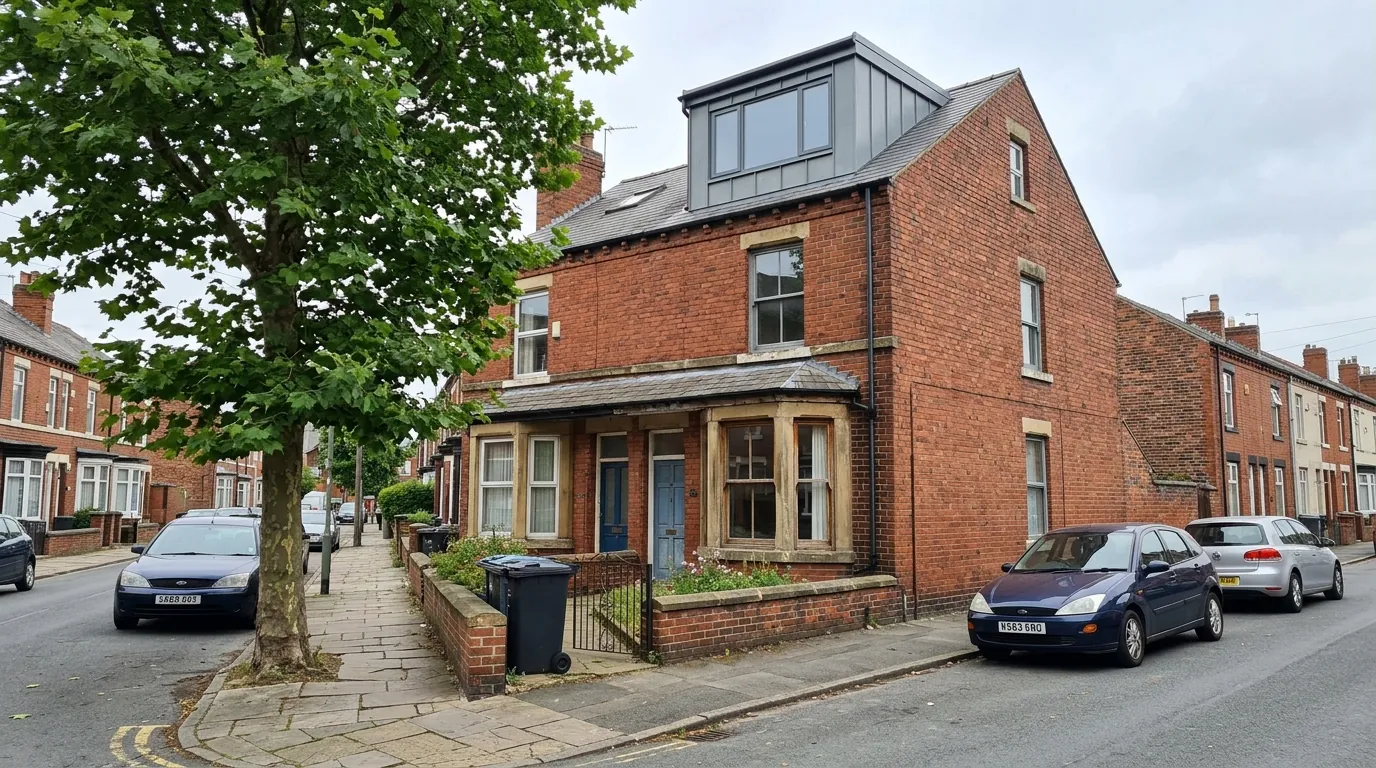
Planning Permission vs Permitted Development: the headline
There are two questions homeowners conflate, and they have different answers.
The first is planning permission. This is whether the council needs to approve your design before you build. For most houses with a rear dormer, a Velux conversion or a hip-to-gable, the answer is no, because Permitted Development covers it.
The second is Building Regulations. This is whether the work meets technical safety standards: fire escape, structural loading, insulation, stair pitch, sound between floors. Every habitable loft conversion in the UK needs Building Regs approval. There is no Permitted Development equivalent for Building Regs. Even if you do not need planning permission, you still need a Building Control sign-off.
A useful rule of thumb: if your home is a house in England, sits outside a conservation area, has no Article 4 Direction on it, is not listed, and your proposed roof addition stays inside the volume limits below, you almost certainly do not need planning permission. If any of those conditions break, assume you do.
Wales has very similar rules under Welsh PD legislation. Scotland and Northern Ireland have their own systems with different volume thresholds and different application routes. The bulk of this guide is England-specific. Where we mention Welsh, Scottish or Northern Irish rules we flag it.
If you are unsure which side of the line your project falls on, a free home survey from UK Loft Conversion will tell you in writing. We do the council-side check before we quote, so the quote you sign reflects the actual route.
Permitted Development rules in detail
Permitted Development for loft conversions is set out in Schedule 2, Part 1, Class B of the Town and Country Planning (General Permitted Development) (England) Order 2015. The Planning Portal and gov.uk both publish plain-English summaries that match what we list below.
Volume limits
- 40 cubic metres of additional roof space on a terraced house. Mid-terrace and end-of-terrace both count as terraced for this purpose.
- 50 cubic metres of additional roof space on a semi-detached or detached house.
The volume is measured against the original roof space. Original here has a specific meaning. It is the roof as it stood on 1 July 1948, or if the house was built after that date, as it was when first built. If a previous owner already added a dormer, that volume is deducted from your allowance. A 1990s rear dormer of 25 cubic metres on a terrace leaves you only 15 cubic metres to play with before you push outside Permitted Development.
Position and design conditions
- The roof extension cannot extend beyond the plane of the existing roof slope on the principal elevation that fronts the highway. In plain English: no dormer windows facing the street. A dormer on the side or rear is fine.
- The extension cannot be higher than the highest part of the existing roof. You cannot raise the ridge.
- The materials must be similar in appearance to the existing house. Slate stays with slate, tile with tile, render with render.
- Side-facing windows on a loft conversion must be obscure-glazed and either non-opening or set at least 1.7 metres above the floor level of the room. This protects neighbour privacy.
- The eaves of the original roof must be maintained or reinstated. Any enlargement must be set back at least 20 centimetres from the original eaves where practical.
- The work cannot include verandas, balconies or raised platforms. A standard Juliet balcony with no projecting platform is sometimes argued case by case.
- It cannot include alteration to any chimney, flue or soil and vent pipe under Class B. Those go through Class C if needed.
Rooflights on the front
Velux-style rooflights on the principal elevation are usually fine under a separate set of rules in Class C, provided they do not project more than 150mm from the roof slope and do not rise above the highest part of the roof. So a Velux conversion that only adds windows to the front and back of an existing roof is the lowest-friction route in planning terms. You still need Building Regs.
Designated land
Permitted Development for loft conversions does not apply at all on designated land. Designated land includes:
- Conservation areas
- National Parks
- Areas of Outstanding Natural Beauty (AONBs)
- The Broads
- World Heritage Sites
If your house sits inside any of these, you start from the assumption that planning permission is required, even for a small rear dormer.
When Permitted Development does NOT apply
This is the part most online guides skim. The cases below force you down the full planning permission route regardless of volume.
Flats and maisonettes
Permitted Development rights for householders apply only to houses. If you own a flat or maisonette, you have no Class B rights at all. Every loft conversion on a flat needs full planning permission, plus freeholder consent, plus often a lease variation. London flat conversions are the most common version of this we see.
Mansard loft conversions
A mansard rebuilds the entire rear roof slope into a near-vertical wall with a shallow flat top. By definition it changes the roof shape across the whole rear elevation and rarely fits inside the 40-50 cubic metre allowance. Mansards almost always need planning permission. In some London boroughs they are encouraged in conservation areas because they sit behind a parapet and barely show from the street. Outside London, councils are more variable.
Listed buildings
A listed building needs Listed Building Consent for any internal or external alteration that affects the character of the building. That is separate from planning permission, applies on top, and has no fee. You will normally also need planning permission because the standard PD rights do not apply to listed buildings. Working on a Grade II terrace in Newcastle's Grainger Town or a Grade II* property in Tynemouth means a heritage statement, a conservation officer in the room, and design choices weighted toward reversibility.
Conservation areas
Class B Permitted Development is removed on roof alterations in conservation areas. A rear dormer that would be PD on the next street is a planning application here. We expand on this in its own section below.
Article 4 Directions
Local councils can remove specific permitted development rights in defined areas through an Article 4 Direction. Where Class B is removed by Article 4, you need planning permission for the same dormer that would be PD next door. Covered in its own section.
Houses that have lost their PD rights through a previous planning condition
If the original planning permission for your house removed PD rights via a condition (common on newer estates from the 2000s onwards), Class B is off the table. The deeds and the original planning decision notice tell you this. Newer-build estate homes are the most common case.
Building Regulations: always required
Even if your project is Permitted Development, Building Regulations approval is non-negotiable. This is the part of the process that catches DIY loft conversions and unregulated builders. A loft converted without Building Regs sign-off is effectively a loft, not a bedroom, and conveyancing solicitors will flag it on every future sale.
The key Building Regs areas for a UK loft conversion are:
Fire safety (Approved Document B)
This is the biggest single Building Regs issue. Adding a third storey changes how the whole house is treated for fire. You need:
- A protected stair enclosure all the way from the new loft down to the final exit door, with fire-rated doors (FD30 minimum) on every habitable room that opens onto it.
- Mains-wired interconnected smoke alarms on every storey.
- A clear escape route. On most three-storey houses this means the existing first-floor doors must be upgraded to FD30 self-closing doors.
- 30 minutes of fire resistance on the new floor structure between the first floor and the loft.
This is why a sensible loft conversion costs more than the floor area suggests. You are not just building one room. You are upgrading the fire compartmentation of the whole house.
Structural (Approved Document A)
The new loft floor needs to carry domestic loading. The existing ceiling joists almost never do. A structural engineer specs new floor joists, ridge support, steel beams and pad stones. On a terrace those steels usually rest on the party wall, which is where the Party Wall Act enters the picture.
Stair (Approved Document K)
The new staircase needs the right pitch, going and headroom. Maximum pitch is 42 degrees. Minimum headroom is 2 metres, with a fixed concession down to 1.9 metres at the centre of the stair on a loft conversion where space is tight. This is one of the most common reasons a Velux conversion in a small terrace becomes structurally tricky.
Insulation (Approved Document L)
The roof and walls of the new loft need to hit current thermal performance targets. For most pitched roofs this means 270-300mm of insulation between and under the rafters, or a warm roof build-up if you cannot lose the headroom.
Sound (Approved Document E)
The new floor between the first floor and the loft needs sound separation, especially if the loft is a bedroom or office above existing bedrooms.
Ventilation and condensation
Mechanical extract in any new ensuite, plus background ventilation in the habitable rooms.
How to apply for Building Regs
Two routes. Either a full plans application to your council's Building Control department (slower, more certainty, around £500-£900 in fees) or a Building Notice (faster, less paperwork, same fees). Most loft conversion specialists run a full plans application because it removes ambiguity on site. The Building Control officer inspects at agreed stages and issues a completion certificate at the end. That certificate is what conveyancers ask for.
How to apply for planning permission
When your project falls outside Permitted Development, the route is a householder planning application. The Planning Portal at planningportal.co.uk is the national front-end. You can apply directly through your council in some areas, but the Portal is the standard.
What you submit
- A completed application form
- A location plan at 1:1250 or 1:2500
- A site/block plan at 1:200 or 1:500 showing the property and its boundaries
- Existing and proposed floor plans
- Existing and proposed elevations
- A roof plan
- A design and access statement on heritage cases
- Photographs of the property in context
- The fee
Accurate drawings matter. Councils reject incomplete applications at validation, which adds weeks. Architects and architectural technologists handle this routinely and it is worth paying for a properly drawn package rather than self-drafting.
Fees in England (from 1 April 2026)
The Town and Country Planning (Fees for Applications) Regulations were uprated by 3.8% on 1 April 2026 in line with September 2025 CPI. The figures you need:
- Householder application (alterations or extensions to a single existing house, which includes most loft conversions): £548
- Planning Portal service charge: £91.02 added on top if you apply through the Portal rather than directly through the council
- Prior approval for a larger rear extension or additional storey: £249
- Listed Building Consent: free
- Discharge of conditions on a householder application: £89 per request
- Non-material amendment: £46
The £258 figure that some older guides quote was the pre-2025 householder fee. It is no longer correct. So is the £528 figure from the April 2025 uplift. The current number is £548.
Fees in Wales are set separately by Welsh Government and are usually lower. Scotland's fees are set by Scottish Government regulations and again differ. Northern Ireland uses a fixed-fee regulatory regime through the planning authorities there.
Timeline
The statutory determination period for a householder application is 8 weeks from the date the application is validated. Validation alone often takes 1-3 weeks after submission while the council checks the paperwork.
In practice:
- Straightforward rear dormer in a non-sensitive area: 8 weeks from validation, sometimes faster
- Conservation area with a consultation period: 10-12 weeks
- Heritage or listed cases that need a conservation officer review: 12-16 weeks
- Anything that ends up at planning committee: add 2-4 weeks
If the council misses the 8-week deadline without agreeing an extension, you have a right to appeal on grounds of non-determination. In practice most applicants agree a short extension because the council is more likely to approve than the Planning Inspectorate.
Article 4 Directions: where they bite
An Article 4 Direction is a local order made by a planning authority that removes one or more specific permitted development rights across a defined area. The legal authority is Article 4 of the Town and Country Planning (General Permitted Development) Order 2015. Where Article 4 removes Class B, a rear dormer that would be PD elsewhere needs a planning application.
Article 4 Directions are not always obvious. They do not show on the property itself. The only reliable way to check is to look at the council's planning maps or call the planning department. Better still, ask whoever is quoting your loft conversion to verify before drawings start.
Where they are common
London
- Kensington and Chelsea: borough-wide Article 4 on basement extensions; multiple area-specific directions; most conservation areas have Class B PD removed
- Camden: Article 4 Directions across Hampstead, South Hampstead, Belsize, Redington/Frognal and Fitzjohns/Netherhall conservation areas, with more under review
- Islington: extensive Article 4 coverage on roof alterations across most conservation areas
- Hackney: Article 4 on a number of conservation areas including De Beauvoir and Clapton
- Westminster: dense Article 4 coverage given the conservation area footprint
If you are buying a London terrace and plan to convert the loft, assume Article 4 applies and check before exchange.
Newcastle and the North East
Newcastle City Council has multiple Article 4 Directions. Two that affect householder permitted development rights directly:
- Northumberland Gardens Conservation Area and Summerhill Conservation Area have Article 4 Directions that restrict householder PD rights
- Saint Peter's Basin has an Article 4 covering householder extensions
Jesmond, Heaton, Sandyford, South Gosforth and Spital Tongues sit under a separate Regulation 7 Direction that restricts to-let boards rather than loft conversions, but the C3 to C4 Article 4 (family dwelling to HMO) applies across large parts of the city and matters if you plan to let rooms.
Tynemouth and the coast
Tynemouth Village Conservation Area covers much of the historic core. Roof alterations there are not under standard Permitted Development and most loft conversions need planning permission. North Tyneside Council publishes the conservation area boundary on its planning portal.
Other notable Article 4 hotspots
- Bath: city-centre conservation area coverage is extensive
- Cambridge: most of the historic centre and Newnham
- York: the city wall conservation area and several adjacent areas
- Edinburgh New Town and Old Town (under Scottish equivalent rules)
The pattern is clear. If your house is in a Victorian or Georgian terrace in a recognisable historic area, you should assume Article 4 covers it until you have evidence otherwise.
Conservation area considerations
Conservation areas were created by the Civic Amenities Act 1967 and councils designate them where they want to preserve the character of an area. There are over 10,000 in England. Many city-centre areas in Newcastle, London, Bath, Edinburgh, Brighton and Bristol are largely covered.
For loft conversions, the headline effect is that Class B Permitted Development is removed. Any roof addition that enlarges the volume of the house needs planning permission. Rooflights flush with the roof slope are sometimes still allowed under a narrower Class C right, but anything that breaks the line of the roof (dormer, hip-to-gable, mansard) needs an application.
What the council looks for
Conservation area officers care about whether the change reads from the public realm. A rear dormer that is hidden behind a parapet on a London terrace and only visible from inside the back garden is often approved. The same dormer on a property where the rear is visible from a public footpath is harder.
What tends to get approved:
- Rear dormers set back from the eaves with lead or zinc cladding rather than render
- Mansard roofs that match the historic precedent of the street
- Rooflights flush with the slope rather than proud
- Materials that match adjacent original work (Welsh slate, clay pantile, original brick stocks)
What tends to get refused:
- Box dormers that span the full width of the rear roof
- Side dormers on hip-end properties where the change reads from the street
- White uPVC windows on Georgian frontages
- Flat-roofed dormers in pitched-roof neighbourhoods where they have no precedent
Practical advice
Most conservation area decisions go better with pre-application advice. Most loft conversion specialists in conservation areas have a working relationship with the local conservation officer and use it. We do this before drawings on every UK Loft Conversion job in a designated area.
Party Wall agreements
The Party Wall etc. Act 1996 is a separate framework from planning and from Building Regs. It governs work that affects a wall shared with a neighbour. It applies in England and Wales. Scotland and Northern Ireland have different rules.
Most loft conversions on terraced and semi-detached houses trigger the Act, because the structural steels that support the new loft floor sit in pockets cut into the party wall.
What counts as notifiable work
Under section 2 of the Act:
- Cutting into a party wall to insert steel beams (section 2(2)(f))
- Raising a party wall to form a dormer between two raised walls (section 2(2)(a))
- Exposing a party wall to the weather when removing the existing rear roof slope (section 2(2)(n))
- Cutting a chimney breast away from a party wall (section 2(2)(g))
All of these are common on a standard rear dormer or mansard conversion on a terrace.
How the notice process works
- You serve a Party Wall Notice on every adjoining owner at least 2 months before work starts on the party structure.
- Each adjoining owner has 14 days to respond. They can consent in writing, or dissent, or do nothing (which counts as dissent).
- If anyone dissents, a party wall surveyor (one shared, or one each) prepares a Party Wall Award. The Award records the existing condition of the adjoining property, sets out exactly what work is allowed and when, and protects both sides if disputes arise later.
- The building owner pays the surveyors' fees. Typical cost for a straightforward rear dormer on a terrace is £700-£1,500 per adjoining owner if it goes to Award, or zero if neighbours consent in writing.
What it does not do
A Party Wall Award is not planning permission. It does not check whether the design is allowed. It only governs the construction process and protects the adjoining property. You still need planning permission (if required) and Building Regs separately.
If the council refuses planning permission
Refusal is not common on straightforward loft conversion applications, but it happens. The council will issue a decision notice listing the reasons for refusal. Read the notice carefully. The reasons fall into a small number of patterns.
Common refusal reasons
- Design and appearance: the dormer is too large, too bulky, the wrong materials or out of character with the street
- Heritage harm: in a conservation area, the proposal harms the character of the area
- Amenity: overlooking, loss of light or loss of privacy to neighbours
- Highway: rare on loft conversions but possible if access changes
- Policy conflict: the proposal conflicts with a specific local plan policy
Your two routes after refusal
Route 1: Redesign and resubmit
If the refusal reasons are specific and addressable, redesigning is almost always faster than appeal. Reduce the dormer size, change the materials, set it back further from the eaves, drop a Juliet balcony. Resubmissions on a previously refused householder application are free if made within 12 months on substantially the same site. Most refusal patterns we see are fixable by redesign in 2-6 weeks.
Route 2: Appeal to the Planning Inspectorate
If you believe the refusal is unreasonable, you can appeal to the Planning Inspectorate. Householder appeals follow a streamlined written-representations route called the householder appeal procedure under section 78 of the Town and Country Planning Act 1990.
- You have 12 weeks from the date of the refusal notice to lodge the appeal.
- There is no fee for a householder appeal.
- The Planning Inspectorate aims to decide the appeal in around 8-12 weeks for the written-representations route.
- The Inspector reviews the file, sometimes visits the site, and issues a decision.
Appeal success rates for householder cases hover around 33-40% depending on the year. They go up materially if the refusal reasons are weak or if council policy was applied inconsistently. They go down materially if the reasons are specific design issues that a redesign could have addressed.
The practical rule: if your refusal is about design specifics, redesign. If it is about whether the principle of converting at all is acceptable, appeal.
Pre-application advice: usually worth it
Pre-application advice (pre-app) is when you ask the council's planning team for an informal view on your project before you formally apply. Most councils charge a fee for this on householder cases, typically £100-£250 depending on the authority. Some London boroughs charge more. Some smaller councils still offer it free.
What you get back is a written response from a planning officer setting out:
- Whether the proposal is likely to be supported in principle
- What changes would improve the chances of approval
- Which policies will be applied
- Whether a conservation officer or tree officer needs to be consulted
It is not a binding decision. The officer who handles the formal application may be a different person and may take a different view. But on heritage, conservation and Article 4 cases, the pre-app letter is usually a fair predictor of the final decision.
We recommend pre-application advice on:
- Any conservation area dormer or mansard
- Listed buildings
- Any house where Article 4 removes Class B
- Larger or unusual designs
- Anywhere a previous application on the property was refused
We do not recommend it on:
- Standard rear dormers on non-designated houses with clear PD rights
- Velux-only conversions
- Hip-to-gable conversions inside the 50 cubic metre limit on detached or semi houses outside any designation
Common scenarios across the UK
A quick orientation for the routes we see most often.
London terraced rear dormer
Usually outside Permitted Development because most London terraces sit in a conservation area or under Article 4. Plan for a planning application, conservation officer input, £548 fee, 10-12 week timeline. London inner mansards run £100,000+. Outer London rear dormers from £52,000-£75,000.
Newcastle Jesmond or Heaton terrace
Mostly within Permitted Development unless the specific street sits under a Newcastle Article 4 or conservation area boundary. A free home survey resolves it. Rear dormers run £37,000-£52,000.
Newcastle Tynemouth Village
Tynemouth Village Conservation Area covers the historic core. Plan for a planning application. Coastal properties also need to address overlooking carefully because neighbour amenity weighs heavily on Tynemouth committee decisions.
Manchester semi-detached hip-to-gable
Most suburban semis in Greater Manchester have full PD rights. The 50 cubic metre allowance covers a hip-to-gable plus a rear dormer comfortably on most 1930s semis. Material match (red brick to red brick, tile to tile) is the only design constraint.
Birmingham detached house Velux conversion
Almost always within PD. Building Regs only. Quickest route on this list at 4-6 weeks on site.
Leeds Victorian terrace mansard
Mansards are not PD. Plan for full planning permission, often a conservation area, Building Regs, party wall on both sides because most Leeds terraces are mid-terrace. Budget for £55,000-£75,000 outside the city centre.
What we cover on a UK Loft Conversion survey
Because we run the same process on every job, every quote starts the same way. The free home survey looks at:
- Whether your property type allows Permitted Development at all (house vs flat)
- Whether you sit in a conservation area, AONB, National Park, or other designated land
- Whether any Article 4 Direction applies to your street
- Whether the property is listed
- Whether prior planning permissions removed PD by condition
- Existing roof structure, headroom and likely structural route
- Likely Building Regs requirements (fire, stair, insulation, structural)
- Likely Party Wall implications
- Realistic cost band for the conversion type that fits the property
You get the answers in writing after the survey. The quote is itemised by stage so you can see exactly what is included. The work carries a 10 year workmanship warranty. If your route turns out to be planning permission rather than PD, we say so up front rather than after you have committed.
Before you book
Frequently asked questions
Do I need planning permission for a loft conversion in the UK?
Probably not, if your home is a house (not a flat), sits outside a conservation area, has no Article 4 Direction on the street, is not listed, and your design stays within the Permitted Development limits (40m3 on a terrace, 50m3 on a semi or detached, no street-facing dormers, materials matching the existing house). If any of those break, you need a full planning application.
How much does planning permission cost in England in 2026?
A householder planning application fee in England is £548 from 1 April 2026, up from £528 in 2025. If you apply through the Planning Portal there is an extra £91.02 service charge. Listed Building Consent is free. Pre-application advice is usually £100-£250. The £548 figure that older guides quote is no longer current.
How long does planning permission take?
The statutory determination period for a householder application is 8 weeks from validation. Add 1-3 weeks for validation itself. Straightforward cases in non-sensitive areas finish in around 9-11 weeks total. Conservation area or heritage cases run 10-16 weeks. If the council misses the deadline without agreeing an extension, you can appeal on grounds of non-determination.
Do I need planning permission for a Velux loft conversion?
Usually no. Rooflights flush with the roof slope are covered by Class C Permitted Development on most houses outside designated land, provided they do not project more than 150mm from the slope and do not rise above the ridge. Conservation areas, Article 4 Directions and listed buildings can still take this away. Building Regs are always required.
Do mansard loft conversions need planning permission?
Yes, almost always. A mansard rebuilds the entire rear roof slope and rarely fits inside the 40-50 cubic metre PD allowance. In some London boroughs mansards are actively encouraged in conservation areas because they sit behind a parapet. Outside London they need a careful design and access statement and often a heritage statement.
What is an Article 4 Direction and how do I check if my street has one?
An Article 4 Direction is a local order that removes specific permitted development rights across a defined area. Where it removes Class B (roof alterations), you need planning permission even for a dormer that would otherwise be PD. The only reliable way to check is your council's planning maps or a call to the planning department. London boroughs like Kensington and Chelsea, Camden, Islington, Hackney and Westminster have extensive Article 4 coverage. Newcastle has Article 4 in Northumberland Gardens, Summerhill and Saint Peter's Basin.
Do I need Building Regulations approval even if planning is not required?
Yes. Every habitable loft conversion in the UK needs Building Regs sign-off. This covers fire safety (protected stair, FD30 doors, interconnected smoke alarms), structural (joists, steels), stair pitch and headroom, insulation, sound separation and ventilation. A loft without a Building Control completion certificate is not legally a habitable room and will be flagged by conveyancing solicitors on every future sale.
What happens if planning permission is refused?
You have two routes. Redesign and resubmit (free within 12 months on substantially the same site if the issues are addressable), or appeal to the Planning Inspectorate within 12 weeks of the refusal notice. Householder appeals are free and decided on written representations, usually in 8-12 weeks. Success rates run around 33-40% nationally and are higher when the council's reasons are weak.
Do I need a Party Wall agreement for a loft conversion?
Almost always on a terraced or semi-detached house. The structural steels supporting the new loft floor sit in pockets cut into the party wall, which is notifiable work under the Party Wall etc. Act 1996. You serve a Party Wall Notice 2 months before work starts. If neighbours consent in writing the cost is zero. If a Party Wall Award is needed, surveyor fees typically run £700-£1,500 per adjoining owner, paid by the building owner.
What is the 4 year rule for loft conversions?
The 4 year rule used to mean that unauthorised building work became immune from planning enforcement once it had stood for 4 years. That changed on 25 April 2024: for work carried out after that date in England, the enforcement window is now 10 years under the Levelling-up and Regeneration Act 2023. Work substantially completed before 25 April 2024 still falls under the old 4 year rule. Either way, immunity from enforcement is not the same as approval. A buyer's solicitor will still flag a conversion with no paperwork, so you would want a Lawful Development Certificate (£274) or retrospective permission before selling. Building Regulations enforcement runs on separate rules with no equivalent time limit on the practical consequences. Do not plan a loft conversion around waiting out the clock.
Related pages
- Loft Conversion Types →
- Dormer Loft Conversion →
- Mansard Loft Conversion →
- Hip To Gable Loft Conversion →
- Velux Loft Conversion →
- Cities/Newcastle →
- Cities/Newcastle/Jesmond →
- Cities/Newcastle/Tynemouth →
- Cities/London →
- Cities/Manchester →
- Blog/Conservation Area Rules Uk →
- Blog/How Long Does Loft Conversion Take →
- Blog/Loft Conversion Roi Uk 2026 →
- Loft Conversion Building Regulations →
- How To Convert A Loft →
Ready for a written quote?
Free home survey, a written quote itemised by stage, and a 10 year workmanship warranty.