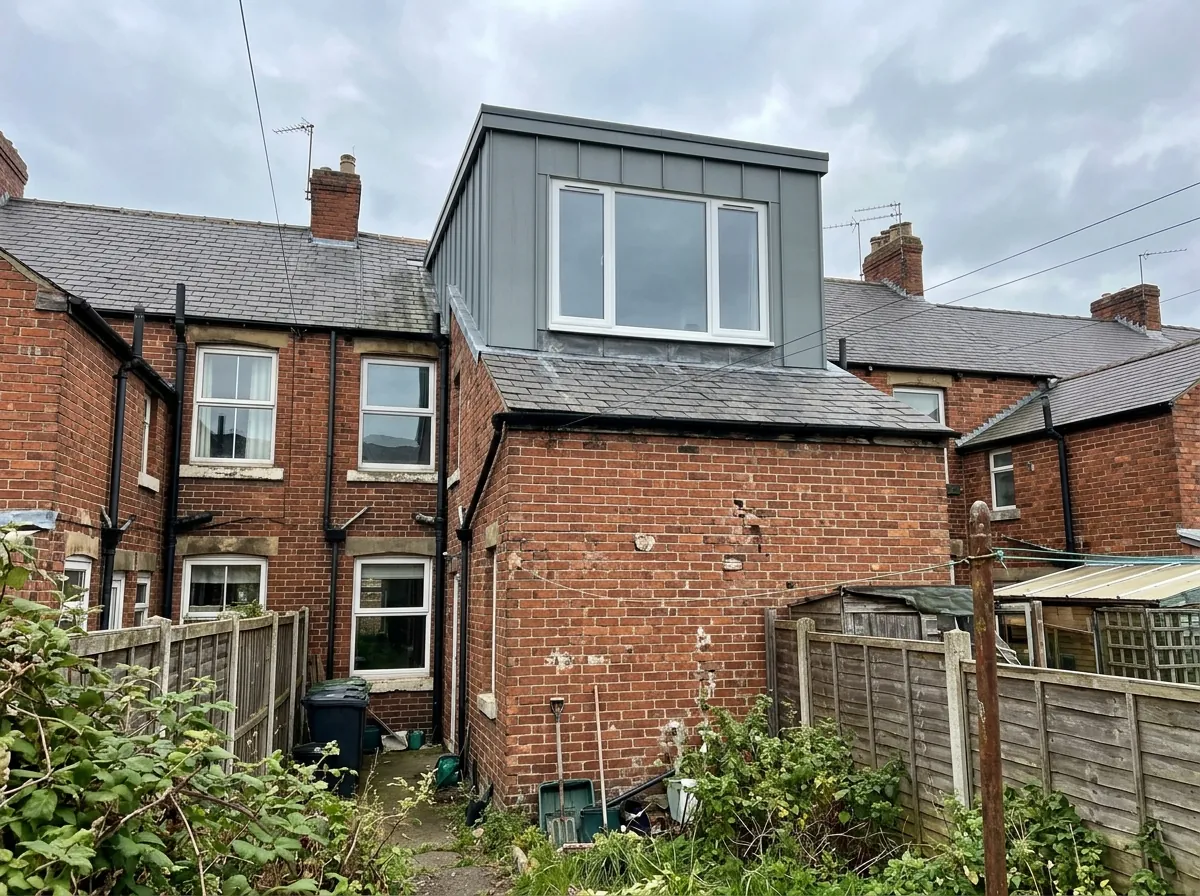
What a dormer loft conversion actually is
A dormer extension is a box that projects out from the existing roof slope. The front face of the box is vertical and holds a full window. The roof of the box is either flat (the most common detail in Newcastle), pitched or with a slight fall for drainage. The two side cheeks are clad in tile, slate or zinc to match or contrast with the existing roof.
The reason dormers dominate around Newcastle is geometry. A standard rooflight conversion (Velux) leaves the sloped ceiling in place, so the only standing-height area sits in the middle of the room. A dormer cuts the slope back and replaces it with a vertical wall, so the entire floor area becomes usable. You can fit a double bed against the back wall, a wardrobe along one cheek and a workable ensuite without ducking. On a typical NE6 Heaton terrace, a rear dormer turns roughly 12 square metres of usable headroom into 22 square metres.
The outside finish matters more than people expect. A poorly proportioned dormer with the wrong cladding looks like a shipping container glued to the roof. A well-designed one reads as a deliberate part of the house. Our surveyors will talk through cladding choices on the survey, with slate or fibre-cement panels being the typical Newcastle defaults.
Why dormers suit Newcastle housing stock
Newcastle and the wider Tyne and Wear conurbation has a fairly narrow set of housing types, and the dormer fits most of them.
Victorian and Edwardian terraces dominate Heaton, Sandyford, parts of Jesmond and the older streets running off Chillingham Road. These have steep pitched roofs with usable height in the ridge but very little floor area at the eaves. A rear dormer extending across most of the rear slope is the standard solution. Build is straightforward because access for materials is usually via the rear lane.
1930s semi-detached houses define Gosforth (NE3), parts of South Gosforth, and large stretches of Whitley Bay and Wallsend. These houses often have a hipped roof at the side, which limits headroom. The classic Gosforth conversion is a rear dormer on its own, or a hip-to-gable combined with a rear dormer where extra width is needed. Front dormers on a 1930s semi are possible but usually need planning permission because they face the highway.
Tyneside flats, the upstairs-downstairs split that runs through Heaton, Walker and parts of Byker, are a special case. The top-floor flat owns the roof, so a loft conversion is only relevant for the upper unit. Party wall surveys are essential because you share structure with the flat below and with both neighbours.
Seaside Victorian and Edwardian townhouses in Tynemouth (NE30) and parts of Whitley Bay (NE26) have generous loft volumes but often sit in conservation areas, which changes the planning route. More on that below.
Newcastle dormer costs in 2026
Across the North East, dormer loft conversions sit around 12 percent below the UK average. For a typical Newcastle property the realistic 2026 range is:
- Rear dormer, one double bedroom, no ensuite: £35,000 to £42,000
- Rear dormer, one double bedroom with ensuite shower room: £40,000 to £48,000
- L-shaped dormer (rear plus over the back addition): £45,000 to £58,000
- Front and rear dormer combined: £48,000 to £62,000
These figures are inclusive of VAT, structural calculations, Building Control fees, steels, joists, the new floor structure, fixed stairs, insulation, plastering, electrics, plumbing where relevant, and second fix finishes to a mid-spec standard. They assume a property in NE1 to NE30 with reasonable access.
What moves the price inside that range is usually one of three things. First, ensuite versus no ensuite, which is roughly a £6,000 to £10,000 swing because of the entire wet trade package. Second, finish level: mid-spec carpet and standard sanitaryware against engineered oak and stone-tiled bathroom can add £8,000 to £15,000. Third, structural complexity, particularly if your roof needs significant strengthening or if you sit on a property where the existing floor joists are undersized.
Per square metre, Newcastle dormers come in at roughly £1,500 to £2,000 against a UK 2026 benchmark of £1,670 to £2,200. Lower contractor day rates across Tyne and Wear do most of the work on the price gap.
Planning permission in Newcastle: where Permitted Development applies
The good news is that most rear dormers in Newcastle are covered by Permitted Development rights, meaning no formal planning application is required. The national rules say a rear dormer is permitted if:
- The roof volume added does not exceed 40 cubic metres on a terraced house or 50 cubic metres on a semi-detached or detached house
- It does not extend forward of the original front roof slope
- It does not exceed the highest part of the existing roof
- Materials are similar in appearance to the existing house
- The side cheeks have obscure glazing if they include windows, and any side window opens no lower than 1.7 metres above floor level
- The property is not a flat
- The property is not in a conservation area, an Article 4 area, or listed
For a standard Heaton terrace, a Gosforth semi or a Wallsend semi with no conservation overlay, that means you can typically proceed without a planning application. We still recommend a Lawful Development Certificate from the relevant council, which is a formal confirmation that your scheme falls within Permitted Development. It costs around half the price of a full planning application and protects you on resale.
Three separate planning authorities cover the area: Newcastle City Council handles NE1 to NE7 and NE15, North Tyneside Council handles NE25 to NE30, and Gateshead Council handles NE8 to NE11. Each runs its own portal and application fees. Our surveyor will tell you which one applies to your address on the free home survey.
When planning permission is required
There are several specific situations in Newcastle where Permitted Development does not apply and you will need a full planning application. Knowing which bucket your property sits in before you start saves weeks of wasted time.
Conservation areas. Newcastle has 12 conservation areas, including Jesmond Dene, Grainger Town, Brandling Village, Saint Peter's Basin, Northumberland Gardens and Summerhill. North Tyneside has its own designated areas including large parts of Tynemouth around the Priory and the front, and stretches of Whitley Bay. Inside any conservation area, you lose the Permitted Development right to add rear dormers, so a planning application is mandatory. Designs are usually scaled back, with rooflights preferred over dormers on visible elevations.
Article 4 areas. Newcastle has Article 4 directions covering parts of Jesmond, Heaton, High West Jesmond, North Jesmond and the Saint Gabriel's Estate, plus household extension restrictions in Northumberland Gardens, Summerhill and Saint Peter's Basin. The dominant directions in Jesmond and Heaton mostly target HMO conversions rather than loft extensions, but always check the specific direction on your street.
Flats. Tyneside flats and any other flat configuration cannot use Permitted Development for a loft conversion. A full planning application is always required.
Front dormers. Any dormer on the front elevation, facing the highway, needs planning consent.
Listed buildings. Listed Building Consent is required in addition to planning permission. These applications take longer and the design freedom is much narrower.
Building Regulations. Separately, every loft conversion in England requires Building Regulations approval regardless of whether planning is needed. Fees in Newcastle typically run £500 to £900, and the process is managed in parallel with the build via the Tyne and Wear Building Control partnership or an approved inspector.
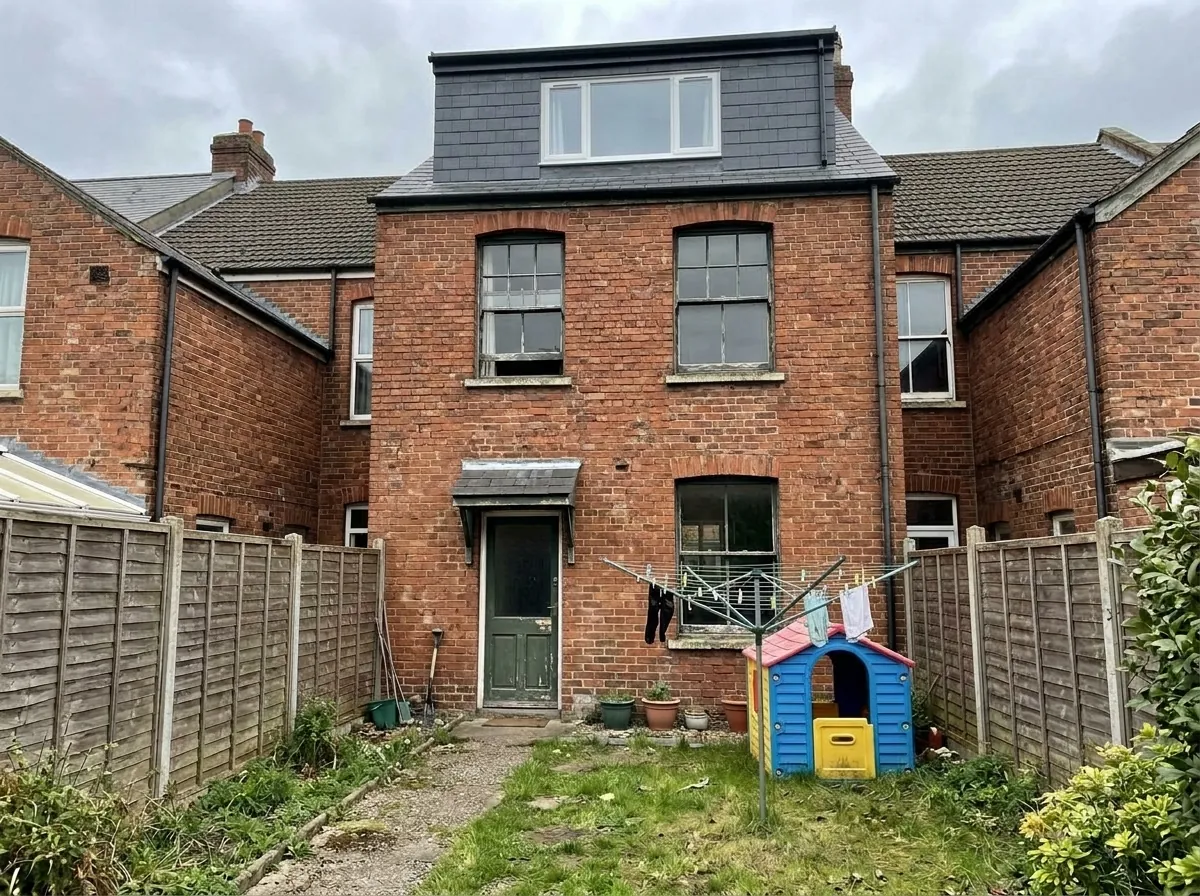
How long the build takes and what happens on site
A typical Newcastle dormer runs 8 to 12 weeks on site, with another 4 to 8 weeks before that for design, planning where relevant, and Building Control sign-off of the structural package. The site phase usually breaks down like this:
- Week 1: Scaffold up, roof strip back, weatherproof tent in place
- Weeks 2 to 3: Structural steels in, new floor joists, dormer carcass framed
- Weeks 4 to 5: Dormer cladding, roof finished and watertight, windows in, scaffold can come down
- Weeks 6 to 7: First fix electrics and plumbing, insulation, stairs installed
- Weeks 8 to 9: Plasterboard, skim, second fix carpentry
- Weeks 10 to 12: Decoration, flooring, sanitaryware, final Building Control inspection and certificate
Most households continue living in the property throughout. The noisy and dusty weeks are 2 to 3 (steel installation) and the stair-cutting day, which is usually a single day where the ceiling below opens up. We coordinate around school runs and home working where we can.
Party wall agreements are almost always required for terraces and semis because the work affects shared structure. We recommend serving notice on your neighbours 8 to 12 weeks before the build start date. The process is administrative rather than adversarial, but it cannot be rushed.
What a dormer adds to a Newcastle home
Across the UK, a well-executed loft conversion typically adds 15 to 25 percent to the value of the property. In Newcastle, where average semi-detached values in Gosforth and parts of Jesmond sit around £350,000 to £450,000, a £40,000 to £48,000 dormer conversion typically returns £55,000 to £80,000 of added value, depending on the area. The gain is largest in the highest-demand postcodes (NE2 Jesmond, NE3 Gosforth, NE30 Tynemouth) where the additional bedroom moves the property into a higher band.
The other gain is practical. A three-bedroom Gosforth semi becomes a four-bedroom family house with an ensuite master upstairs. A two-bed Heaton terrace becomes a three-bed with a proper home office. You stay in your home, keep your school catchment, avoid stamp duty and skip the cost of moving. For families anchored in the catchments around Gosforth Junior High Academy, South Gosforth First School or Heaton Manor, that calculation usually points one way.
How we work and what's included in your quote
UK Loft Conversion gives Newcastle, Gateshead and North Tyneside homeowners a single point of contact, and our build teams work across Tyne and Wear. The route to a written quote is the same in every postcode:
- Free home survey at a time that suits you, including evenings and Saturdays
- Written quote after the visit, itemised by stage so you can see exactly what is included
- Planning and Building Control package prepared and submitted on your behalf
- Scope agreed in writing before we order materials, with inclusions and exclusions listed
- 10 year workmanship warranty issued on completion alongside Building Control certificate
Included as standard in every Newcastle dormer quote: structural design and calculations, all steels and timber, the new floor structure, dormer construction and cladding, double-glazed windows, fixed staircase, full insulation pack to current Building Regs, plasterboard and skim throughout, first and second fix electrics with new circuit, central heating extension, painted finish, and final clean. Optional items priced separately include ensuites, premium joinery, premium flooring and rooflights additional to the main dormer windows.
Before you book
Frequently asked questions
How much does a dormer loft conversion cost in Newcastle in 2026?
A typical rear dormer with one double bedroom costs £35,000 to £42,000 fitted in Newcastle, rising to £40,000 to £48,000 with an ensuite shower room. L-shaped dormers and combined front-and-rear schemes run £45,000 to £62,000. North East pricing sits around 12 percent below the UK average because of lower contractor day rates across Tyne and Wear.
Do I need planning permission for a rear dormer in Newcastle?
Most rear dormers on terraces and semis in Newcastle, Gateshead and North Tyneside fall within Permitted Development, so a full planning application is not required. The main exceptions are conservation areas (including Jesmond Dene and large parts of Tynemouth), Article 4 areas, flats including Tyneside flats, listed buildings, and any dormer on the front roof slope. We recommend a Lawful Development Certificate even when Permitted Development applies, to protect resale value.
How long does a dormer loft conversion take to build?
Site work on a typical Newcastle dormer runs 8 to 12 weeks. Design, planning where needed and Building Control sign-off of the structural package usually take another 4 to 8 weeks beforehand. Most households continue living in the property throughout the build, with the noisiest phases being steel installation in weeks 2 to 3 and stair cutting, usually a single day.
Which Newcastle suburbs are best suited to a dormer?
Rear dormers work particularly well on Victorian and Edwardian terraces in Heaton, Sandyford and parts of Jesmond. They are the standard solution on 1930s semis across Gosforth, Wallsend and Whitley Bay. Tynemouth townhouses can usually take a dormer too, though the conservation area covering much of the suburb means a planning application is required and rooflight schemes are often preferred.
Will I need a party wall agreement?
Almost always, yes. Terraces share walls with both neighbours and semis share with one. Any structural work affecting that shared wall, including new steels bearing onto it, falls under the Party Wall Act. The process is administrative rather than adversarial. We recommend serving notice on neighbours 8 to 12 weeks before the planned start date so the timeline does not slip.
Which council handles my planning application?
Newcastle City Council handles postcodes NE1 to NE7 and NE15, covering the city centre, Heaton, Jesmond, Gosforth and Walker. North Tyneside Council handles NE25 to NE30, covering Whitley Bay, Tynemouth, Wallsend and North Shields. Gateshead Council handles NE8 to NE11. Our surveyor confirms which authority applies to your address on the free home survey.
What is included in your written quote?
Every Newcastle dormer quote includes structural design and calculations, all steels and timber, the new floor structure, dormer construction and cladding, double-glazed windows, fixed staircase, full insulation, plasterboard and skim throughout, first and second fix electrics with a new circuit, central heating extension and painted finish. We issue the quote after the home visit and back the work with a 10 year workmanship warranty.
How much value does a dormer add to a Newcastle home?
A well-executed dormer conversion typically adds 15 to 25 percent to the property value. On a £350,000 to £450,000 Gosforth semi or Jesmond terrace, a £40,000 to £48,000 dormer commonly returns £55,000 to £80,000 of added value. The gain is largest in the highest-demand postcodes where the extra bedroom moves the property into a higher price band.
Related pages
- Cities/Newcastle →
- Cities/Newcastle/Cost →
- Cities/Newcastle/Planning Permission →
- Cities/Newcastle/Jesmond →
- Cities/Newcastle/Gosforth →
- Cities/Newcastle/Heaton →
- Cities/Newcastle/Tynemouth →
- Cities/Newcastle/Whitley Bay →
- Cities/Newcastle/Hip To Gable →
- Cities/Newcastle/Mansard →
- Cities/Newcastle/Velux →
- Dormer Loft Conversion →
- Loft Conversion Cost →
- Loft Conversion Planning Permission →
- Loft Conversion Types →
- Types Of Dormer →
- Cities/Gateshead/Dormer →
- Cities/Sunderland/Dormer →
- Cities/South Tyneside/Dormer →
- Cities/North Tyneside/Dormer →
Ready for a written quote?
Free home survey, a written quote itemised by stage, and a 10 year workmanship warranty.