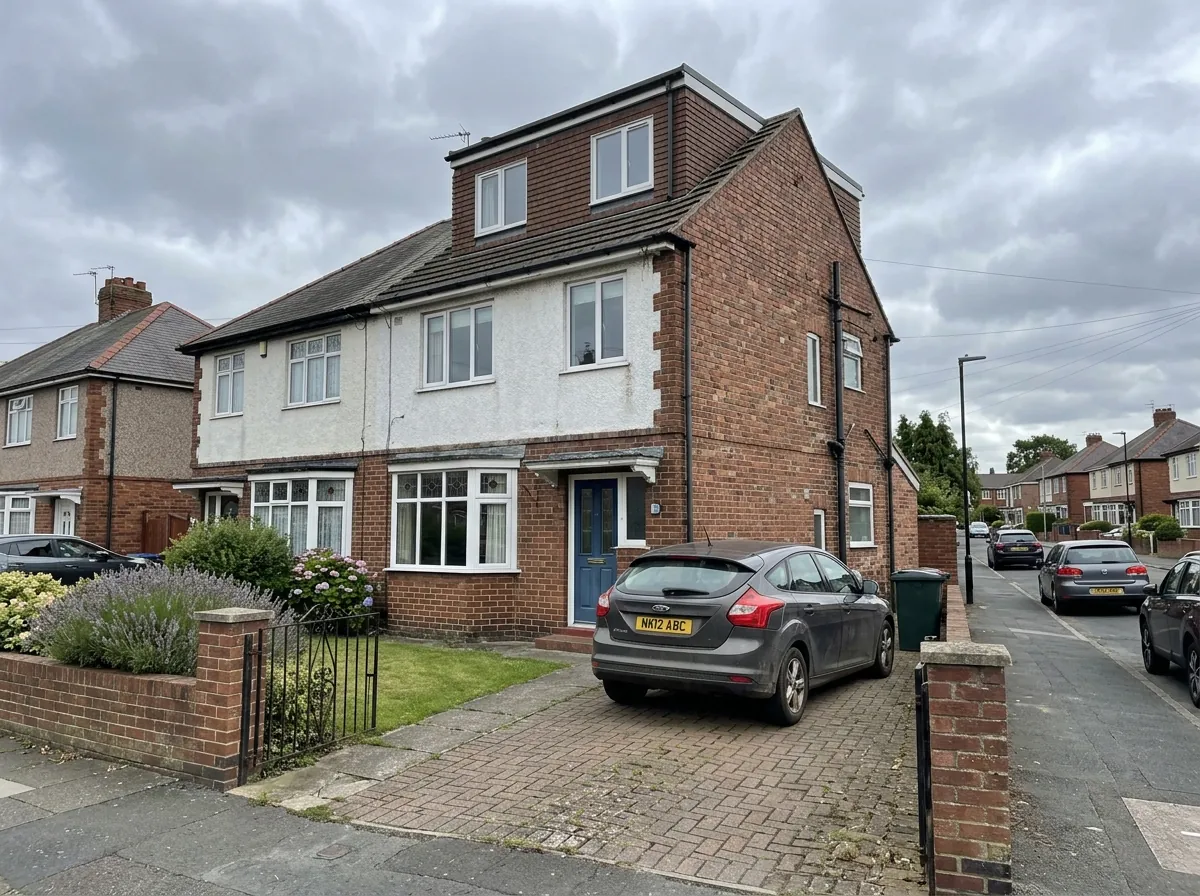
Why Gosforth lofts are almost always hip-to-gable
Gosforth was built out in waves. The Graham Park estate by William Hope went up from the late Edwardian period as imposing terraces and large semi-detached villas on Graham Park Road, Elmfield Road, Oaklands and The Drive. The Kenton Park estate followed from 1923, and the bulk of what you see today, the red brick 1930s semis with hipped clay tile roofs and curved bays, came in the inter-war push between the two world wars.
The hipped roof was the standard detail of that period and it is the single biggest factor in your loft. A hip slopes down on three sides instead of finishing in a vertical gable. That means the useful headroom in your loft sits only down the narrow spine of the house. Stand in a typical Fernville Road or Oakfield Road loft today and you can stand up along a strip maybe a metre and a half wide. Everywhere else the ceiling is on you.
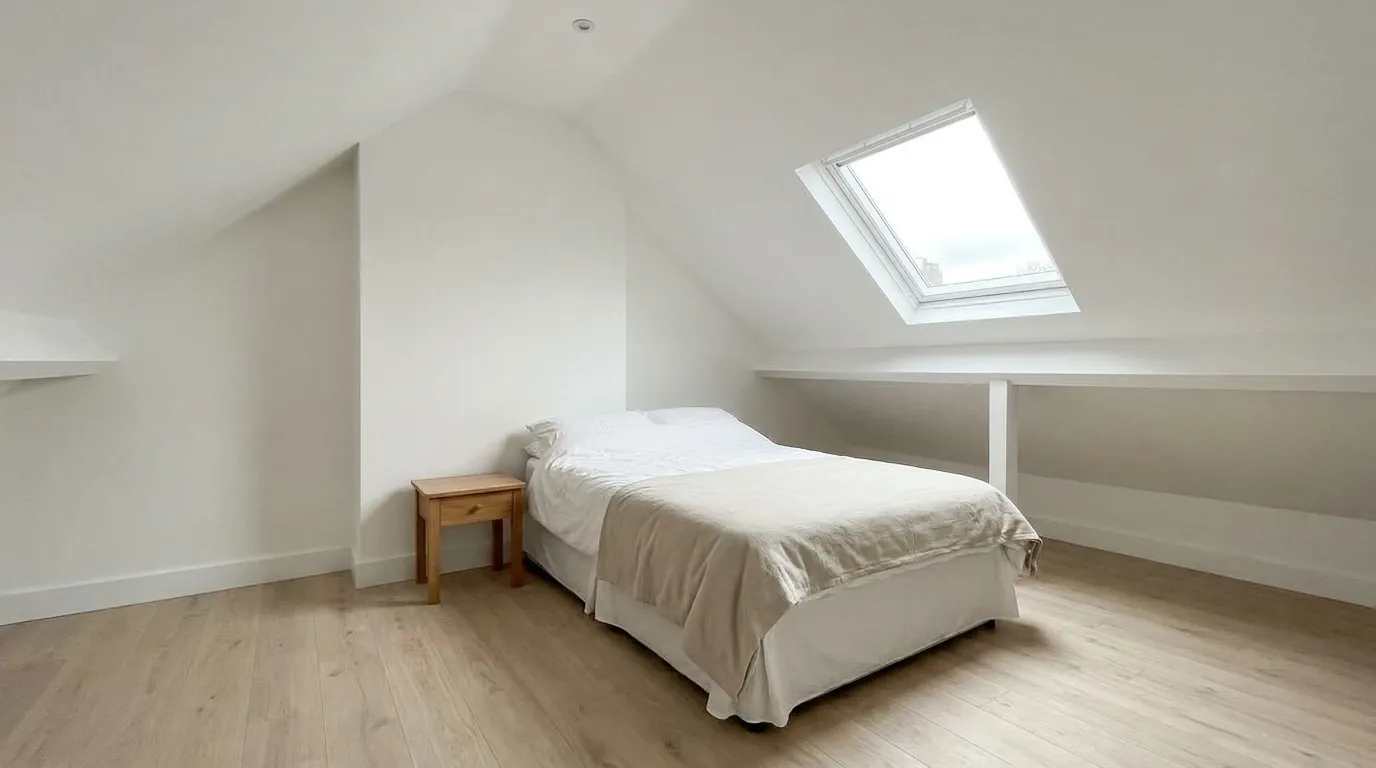
The fix is hip-to-gable. We build the hip up into a full vertical brick gable wall on the side elevation, matching the existing brick and detailing. That alone gives you a usable loft floor right across the width of the house. Pair it with a rear dormer and you have a double bedroom with an en-suite and proper standing headroom across the whole space. This is why hip-to-gable plus rear dormer is the default Gosforth design, and why we quote it more than anything else in NE3. The rear dormer you pair with the new gable changes both the headroom and the light you end up with, so it is worth comparing the main dormer types before you settle a design.
What it costs on a typical NE3 property
Newcastle and the wider North East run roughly 12 percent below the UK average for loft conversion costs. Material prices are similar but labour day rates and overhead are lower than the South East or even the Midlands. Gosforth is at the higher end of the local market because the properties are larger and the finish expectation is higher.
Typical fully fitted prices in NE3, mid-spec, building control inclusive:
- Velux conversion (rooflights only): £22,000 to £32,000
- Rear dormer on an Edwardian terrace or smaller semi: £35,000 to £48,000
- Hip-to-gable with rear dormer on a 1930s semi: £45,000 to £58,000
- L-shaped dormer on a larger Graham Park semi: £50,000 to £65,000
- Full second-floor conversion on a larger villa: £60,000 plus
Those figures include structural calculations, party wall surveyor where required, building control fees of £500 to £900, full electrics and plumbing, plastering and decoration, one en-suite, and a 10 year workmanship warranty.
Things that push the number up: custom joinery for fitted wardrobes (Gosforth buyers expect them), upgraded glazing on the dormer to keep the conservation officer happy, soil pipe relocation if the existing run does not stack neatly, and steelwork for unusual spans. Things that pull it down: properties that already have a stairwell aligned for a straight loft staircase, and lofts that already have decent ridge height from a steeper original pitch.
Planning permission and the Gosforth Conservation Area
This is where Gosforth gets specific, and where we save people the most money before any tools come out.
The Gosforth Conservation Area was designated in April 2002. It covers a large slice of the suburb including the Graham Park estate (Graham Park Road, Elmfield Road, The Drive, Oaklands, Moor Place, Leslie Crescent), Moor Crescent, parts of Fernville Road, Woodlands, the Kenton Park area, the original Bulman Village around Gosforth High Street, and a good portion of the older streets around Ivy Road, Hawthorn Road, West Avenue and Causey Street. If your property sits inside that boundary, your permitted development rights on the roof are reduced and a planning application is needed for almost any change visible from the street.
Newcastle City Council also publish a Householder Design Guide that specifically discourages hip-to-gable alterations on semi-detached or terraced houses, because converting one half of a matched pair unbalances the streetscape. Inside the conservation area that guidance is enforced strictly. Outside it, hip-to-gable on a semi is achievable but the design still needs to be sympathetic.
There is also a separate Article 4 direction across parts of South Gosforth (and Jesmond, Heaton, Sandyford, Spital Tongues and Ilford Road) covering changes from family dwelling to HMO. That one does not affect a standard family loft conversion, but if the plan was ever to let the property to students it changes the legal route.
What this means in practice:
- Conservation area plus 1930s hipped semi: we usually design a discreet rear dormer set below the ridge, finished in matching tile, with traditional sash windows. Planning is needed but achievable.
- Conservation area plus Edwardian terrace: rear dormer with sympathetic detailing, planning required.
- Outside the conservation area plus 1930s hipped semi: full hip-to-gable plus rear dormer, often inside the 50m3 permitted development cap, lawful development certificate to lock it in.
- Any flat or maisonette: planning required, and permitted development is not available.
Building Regulations approval is always required regardless of planning route. Fees with Newcastle City Council typically run £500 to £900 for a loft conversion.
The Gosforth buyer angle
Most people we quote in NE3 are families either moving in or trying to stop themselves moving out. Gosforth is one of the strongest school catchments in Newcastle. Archibald First, South Gosforth First, Gosforth Junior High Academy and Gosforth Academy are all within a tight radius, and Newcastle High School for Girls and the Royal Grammar School pull in fee-paying parents from across the city. The result is a buyer pool that values bedroom count and an en-suite far more than open-plan ground-floor space.
That changes the maths on whether to convert. A four-bedroom 1930s semi on the Graham Park side of Gosforth currently sells in the £450,000 to £600,000 range. Going from three to four bedrooms with an en-suite, the standard hip-to-gable plus dormer outcome, tends to add 15 to 25 percent. On a £475,000 starting property that is £71,000 to £118,000 of headline value against a £45,000 to £55,000 build cost. The economics are strong enough that we see plenty of homeowners doing the conversion as a deliberate pre-sale move 12 to 18 months ahead of listing.
Near Newcastle Racecourse on the western edge of NE3 (NE3 5 and parts of NE3 3) the housing stock shifts toward slightly later 1950s and 1960s semis with pitched rather than hipped roofs. Those convert more cheaply because the hip-to-gable step is not needed. A rear dormer alone often does the job at the £35k to £45k end of the range.
What our Gosforth process looks like
- Free home survey. A surveyor visits the property, takes ridge height, measures the existing roof structure, checks the stair alignment, looks at the party wall condition, and photographs the front elevation for the planning view.
- Free written quote after the home visit. Broken down by stage, with the inclusions and exclusions written out so you can see exactly what you are buying.
- Planning route confirmed before drawings. Inside the conservation area we recommend a pre-application enquiry with Newcastle City Council before committing to drawings. Outside it we apply for a lawful development certificate to prove the permitted development route is sound.
- Structural design and building control. Structural engineer produces calculations for the new steels and the new floor. Drawings go to Newcastle building control under a full plans application.
- Party wall notices served. Two months before work starts if your neighbour is being formal about it, sooner if they sign straight away.
- Build. 8 to 14 weeks on site depending on type. Scaffolding goes up, roof comes off in sections, steels go in, new floor and walls, then weathered in within the first two to three weeks. The rest is internal trades.
- Completion certificate and 10 year workmanship warranty. Building control sign-off and the warranty paperwork land in your inbox the week we hand back the keys.
Before you book
Frequently asked questions
How much does a loft conversion cost in Gosforth?
For most Gosforth 1930s semis, a hip-to-gable with a rear dormer lands between £45,000 and £58,000 fully fitted. A simple Velux conversion on a property that already has the headroom can come in under £30,000. A larger five-bedroom family conversion on Graham Park Road or Elmfield Road can push past £65,000 because of the extra structural work and finish level. All figures assume mid-spec finish, building control, structural calcs, and a written quote itemised by stage.
Do I need planning permission for a loft conversion in Gosforth?
Often yes. Properties inside the Gosforth Conservation Area, which covers a large area around Graham Park Road, Elmfield Road, Moor Crescent, Ivy Road, Hawthorn Road and the high street, lose much of their permitted development on the roof. Newcastle City Council also discourages hip-to-gable alterations on semis in those streets because they unbalance the pair. Outside the conservation area and outside the South Gosforth HMO Article 4 zone, a rear dormer on a semi can often go ahead as permitted development inside the 50m3 cap. We confirm status with a pre-application enquiry or a lawful development certificate before any drawings are committed.
Why is hip-to-gable so common in Gosforth?
The 1930s semis that dominate NE3 were built with hipped roofs in plain clay tiles. The hipped slope eats into the loft, leaving headroom only down the spine of the house. Converting the hip to a gable wall on the side elevation recovers a full second floor under the existing roof and lets you sit a dormer to the rear. The trade-off is appearance. Inside the conservation area the council usually refuses hip-to-gable on semis to protect the matched pair, which is why we steer those owners toward a discreet rear dormer or a Velux scheme instead.
How long does a loft conversion take in Gosforth?
A Velux scheme on a 1930s semi runs 4 to 6 weeks on site. A rear dormer is typically 8 to 12 weeks. A hip-to-gable with rear dormer, the most common Gosforth job, is 10 to 14 weeks once we are on site, with a further 6 to 10 weeks for design, structural calculations, building control submission, and any planning application. Party wall notices add 2 months minimum if neighbours do not consent in writing straight away.
Will a loft conversion add value to a house in Gosforth?
Gosforth is a buyer-driven market, and most of the demand is from families relocating for the schools (Gosforth Academy, Archibald First, South Gosforth First). Adding a fourth or fifth bedroom plus an en-suite tends to lift the asking price by 15 to 25 percent on a 1930s semi. On a £450,000 property that is £67k to £112k of value against a £45k to £58k spend. The uplift is strongest when the loft is set up as a proper double with an en-suite rather than squeezed into a study or single bedroom.
Do I need a party wall agreement on a Gosforth semi?
Almost always. The semis along Fernville Road, Oakfield Road, Kenton Road, Moor Crescent and the Graham Park estate share a structural party wall with the neighbour. Any steel beams bearing on that wall, any cutting into it for a new opening, and any work to the shared chimney stack triggers the Party Wall etc. Act 1996. We serve notices on your behalf, and budget 6 to 8 weeks for the process. A friendly neighbour can sign the notice immediately and skip the surveyor stage.
Can you do a loft conversion on an Edwardian terrace in Gosforth?
Yes. The older Edwardian and late Victorian terraces around Ivy Road, Hawthorn Road, West Avenue and Causey Street tend to take a rear dormer well, because the roof pitch is steeper and gives more usable headroom from the start. The catch is most of those streets sit inside the conservation area, so a rear dormer needs planning permission rather than relying on permitted development. We design these to sit below the original ridge, set back from the eaves, and finished in matching slate or tile.
Do you cover all of NE3?
Yes. We work across NE3 1 (South Gosforth, around the Metro), NE3 3 (the Graham Park and High Gosforth area), NE3 4 (around the High Street and Salters Road) and NE3 5 (Coxlodge and the western edge near the racecourse). We also cover the rest of Newcastle, North Tyneside and Gateshead from the same Newcastle team, so a hip-to-gable in Gosforth is run by the same surveyors and trades that handle our Jesmond and Heaton jobs.
Related pages
- Cities/Newcastle →
- Cities/Newcastle/Jesmond →
- Cities/Newcastle/Heaton →
- Cities/Newcastle/Hip To Gable →
- Cities/Newcastle/Dormer →
- Cities/Newcastle/Velux →
- Cities/Newcastle/Cost →
- Cities/Newcastle/Planning Permission →
- Hip To Gable Loft Conversion →
- Dormer Loft Conversion →
- Loft Conversion Cost →
- Loft Conversion Planning Permission →
- Cities/Newcastle/Ponteland →
- Types Of Dormer →
Ready for a written quote?
Free home survey, a written quote itemised by stage, and a 10 year workmanship warranty.