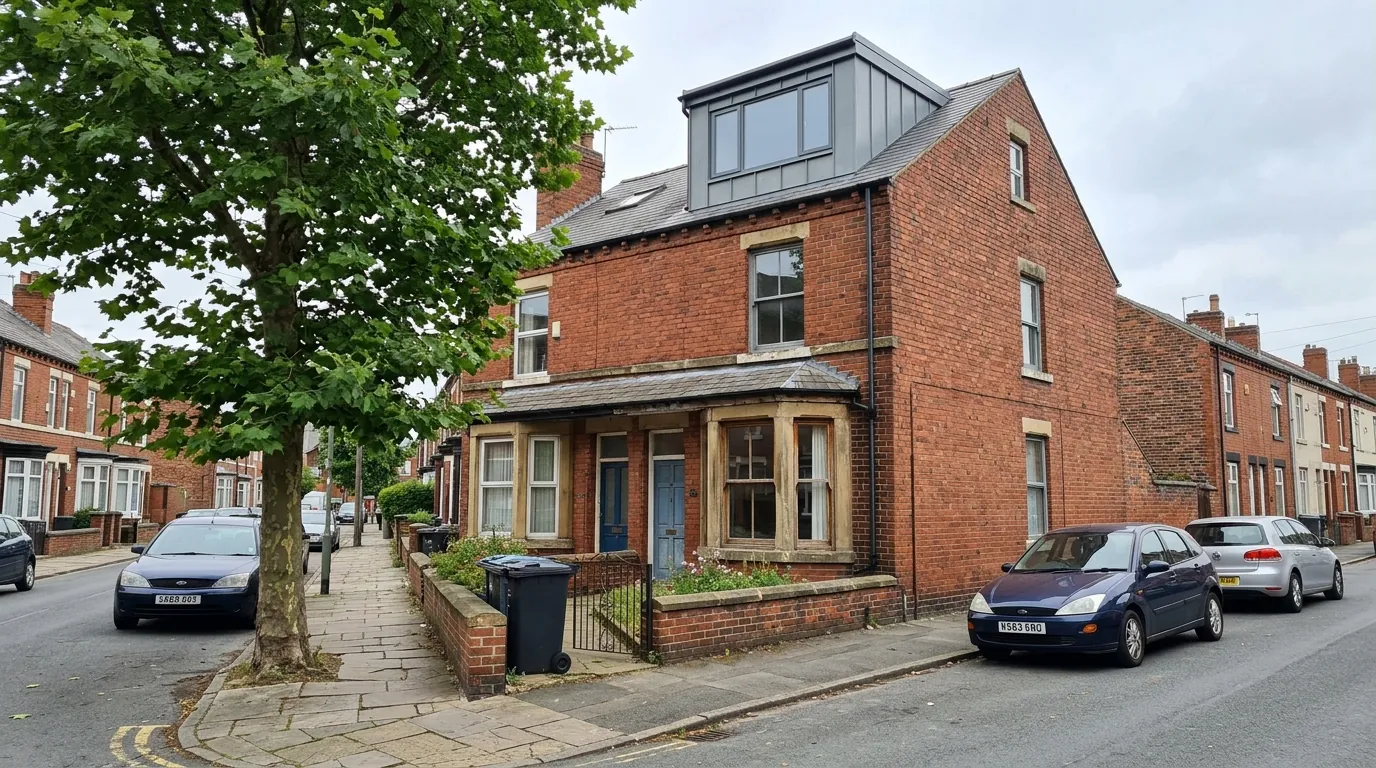
Loft conversion costs in Leeds 2026
Yorkshire and the North West sit around 7% below the UK average on build cost. For a typical Leeds three-bed semi or terrace with a rear dormer, expect the following ranges for a mid-spec finish, fitted and decorated.
- Velux or rooflight conversion: £20,000 to £32,000
- Rear dormer (most common in Leeds): £37,000 to £52,000
- Hip-to-gable (typical for 1930s Horsforth semis): £42,000 to £58,000
- L-shaped dormer (Victorian terraces with back addition): £45,000 to £60,000
- Mansard (rare outside conservation work): £52,000 to £78,000
Per square metre rates in Leeds usually fall around £1,550 to £2,050 for a dormer, £1,900 to £2,300 for a hip-to-gable, and £900 to £1,150 for a Velux. Yorkshire stone matching adds cost where the front or side elevation is visible from the street, especially in conservation areas. Steel beam work in older terraces sometimes adds £1,500 to £3,000 because of party wall and load path issues. See our full guide at loft conversion cost for the UK picture.
How long a loft conversion takes in Leeds
Build times in Leeds match the UK norm. The structural sequence does not change with postcode.
- Velux conversion: 4 to 6 weeks on site
- Rear dormer: 8 to 12 weeks on site
- Hip-to-gable: 10 to 14 weeks on site
- Mansard: 12 to 16 weeks on site
Add 6 to 10 weeks before site start for design, structural calculations, party wall agreements (very common on Headingley and Hyde Park terraces), and either a Permitted Development Certificate of Lawfulness or a full planning application. If your property sits inside an Article 4 area or a conservation area, the planning route adds a further 8 to 10 weeks. For a deeper breakdown of build sequencing across types, see loft conversion types.
Planning permission and Article 4 in Leeds
Leeds City Council is the local planning authority for almost all of the city. Two rules drive most loft conversion decisions here.
Permitted Development. Most dormers and Velux conversions on a house qualify under Permitted Development if the volume stays within 40 cubic metres for a terrace or 50 cubic metres for a semi or detached, and the dormer is set back from the eaves. A Certificate of Lawful Development is strongly recommended before you start, because conveyancing solicitors will ask for it when you sell.
Article 4 directions. Leeds has Article 4 directions that remove some permitted development rights, mainly to control the growth of HMOs. Wards covered include Headingley, Chapel Allerton, Roundhay and Weetwood, Hyde Park and Woodhouse, Horsforth, Kirkstall, Moortown, Adel and Wharfedale, Armley, Bramley and Stanningley, and others. The Article 4 in Leeds mostly targets HMO conversion rather than family loft conversions, but it is worth checking the ward map before assuming PD applies.
Conservation areas. Leeds has more than seventy conservation areas. Headingley, Roundhay, Gledhow Valley, Chapel Allerton, and parts of Horsforth all have appraisals that affect materials, roof form, and dormer design. Conservation area work almost always needs a full planning application. Stone or stone-effect cladding on the front and side dormer cheeks is normally expected.
Building Regulations. Always required for a loft conversion, regardless of planning route. Typical fees run £500 to £900 through Leeds Building Control or an approved inspector.
More detail on the UK rules at loft conversion planning permission.
Areas we cover in Leeds
We take jobs across every LS postcode. The four below cover most of our Leeds enquiries.
Headingley (LS6). Mostly back-to-back and through terraces in Yorkshire stone or red brick. Rear dormers and L-shaped dormers are the standard play, giving a double bedroom with ensuite over the back addition. Article 4 applies and the Headingley Hill conservation area pushes design toward stone-effect cheeks and slate-matching tiles. Party wall agreements are nearly universal here.
Roundhay (LS8, LS17). Large Victorian and Edwardian villas around Roundhay Park, plus interwar semis. Many villas already have usable attic space and benefit most from a Velux or small rear dormer that preserves the roofline. The Roundhay and Gledhow Valley conservation areas restrict visible alterations. Hip-to-gable conversions on Roundhay semis often unlock the largest gain in floor area.
Chapel Allerton (LS7). Victorian and Edwardian terraces along Harrogate Road, plus a stock of 1930s semis on the side streets. Article 4 covers the ward. Most jobs are rear dormers on terraces or hip-to-gable plus dormer on semis. Stone heads and lintels on period properties need matching.
Horsforth (LS18). Mix of traditional Yorkshire stone terraces in the village centre and 1930s semis on Brownberrie Lane and around. Hipped roofs on the semis suit a hip-to-gable conversion, which adds around 25 to 30 square metres of usable floor. Horsforth also sits inside the Article 4 area for HMOs, though standard family loft conversions are usually unaffected.
We also cover Moortown, Alwoodley, Meanwood, Adel, Cookridge, Kirkstall, Bramley, Pudsey, Garforth, Wetherby, Otley, Guiseley, Yeadon, Rothwell, Morley, and the wider LS catchment.
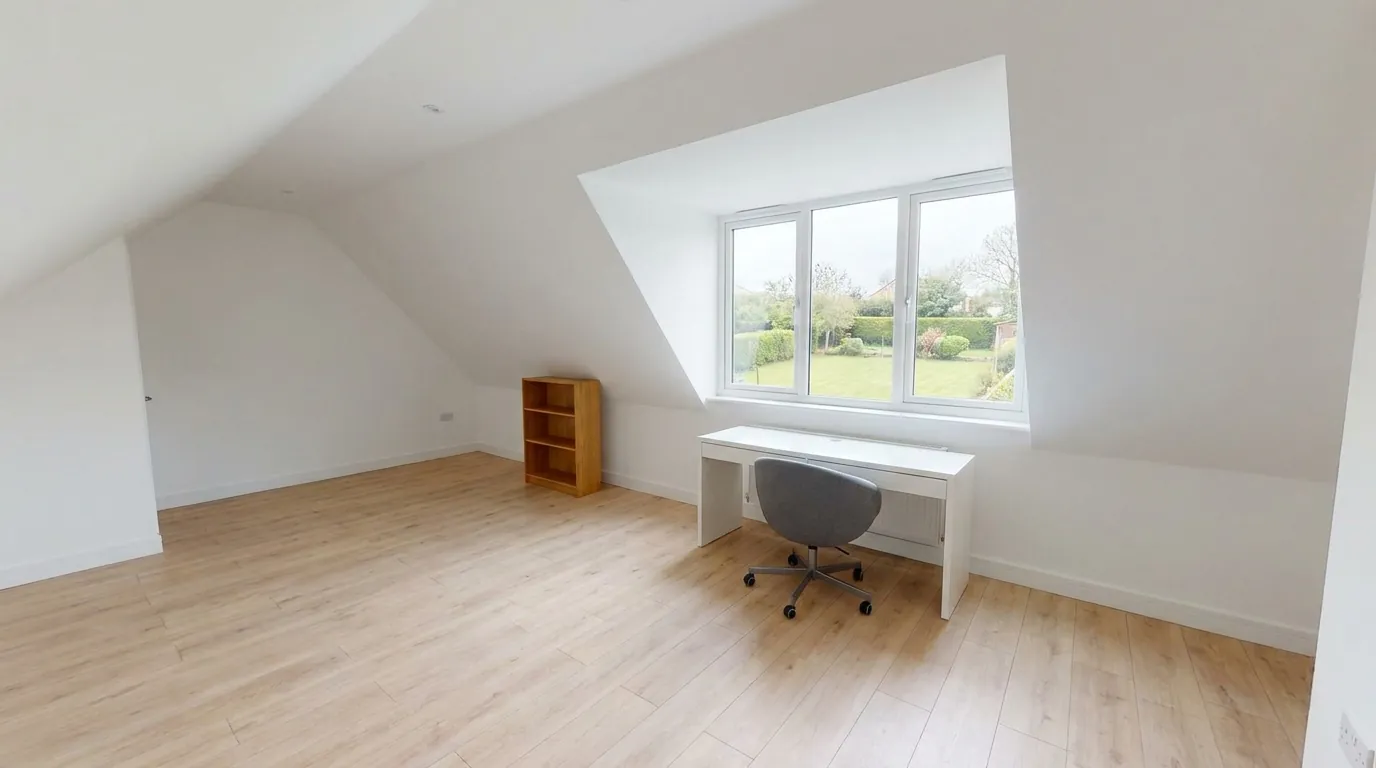
Which conversion type suits Leeds housing
The right conversion depends mostly on roof shape and the planning route available.
- Yorkshire stone through terraces in Headingley, Chapel Allerton, and inner Horsforth. Best fit is a rear dormer loft conversion, often L-shaped if there is a rear addition. Adds a double bedroom plus a small ensuite within a 40 cubic metre PD allowance for a terrace.
- 1930s semis with hipped roofs in Horsforth, Moortown, and Roundhay outer streets. A hip-to-gable loft conversion squares off the side roof, then a rear dormer adds height. Total uplift commonly 25 to 35 square metres of usable space.
- Victorian villas around Roundhay Park, Headingley Hill, and parts of Chapel Allerton. A Velux loft conversion is often the cleanest option because conservation appraisals discourage visible dormers and the roof pitch is generous.
- Inner-city flats and listed buildings. Loft conversions are rare and almost always need full planning. A mansard loft conversion is occasionally used on inner Leeds terraces but is uncommon outside conservation work.
Return on investment in Leeds
Estate agent and surveyor data across Yorkshire shows a loft conversion typically adds 15% to 25% to the home value. A Roundhay semi at £450,000 can move to £530,000 to £560,000 after a £45,000 to £55,000 hip-to-gable plus dormer with two bedrooms and a bathroom. A Headingley terrace at £300,000 can move to £350,000 to £375,000 after a £40,000 rear dormer adding one bedroom and an ensuite. Yorkshire stone matching and a Velux at the front to preserve street character usually protect resale value in conservation areas. Energy efficiency upgrades to 0.18 W/m2K roof insulation are now standard under Building Regs and play well with buyers.
How we work with Leeds homeowners
We are a new brand, and we survey, quote and build every job ourselves. The fee model is straightforward.
- Free home survey. A surveyor walks the loft, measures, photographs, and discusses options.
- Written quote after the home visit. It is itemised by stage so you can see exactly what is included.
- 10 year workmanship warranty on the build.
- Single point of contact through design, planning, party wall, and build.
- Local Leeds crews only. The crew on site lives near you and knows Leeds Building Control and Yorkshire stone supply.
For the full city playbook including planning examples and case studies on Newcastle housing stock, see our Newcastle hub. The build process is the same across the UK, and the planning authority is the main thing that changes.
Before you book
Frequently asked questions
How much does a loft conversion cost in Leeds?
Typical Leeds prices in 2026 are £20,000 to £32,000 for a Velux conversion, £37,000 to £52,000 for a rear dormer, £42,000 to £58,000 for a hip-to-gable on a 1930s semi, and £45,000 to £60,000 for an L-shaped dormer on a Victorian terrace. Yorkshire and the North West sit around 7% below the UK average.
Do I need planning permission for a loft conversion in Leeds?
Most rear dormers and Velux conversions on houses fall under Permitted Development, with a 40 cubic metre limit for terraces and 50 cubic metres for semis and detached homes. Conservation areas including Headingley, Roundhay, and Gledhow Valley always need full planning. Article 4 directions across several Leeds wards mainly target HMOs but should be checked before assuming PD applies. Building Regulations are required in every case.
How long does a loft conversion take in Leeds?
On site time is 4 to 6 weeks for a Velux, 8 to 12 weeks for a rear dormer, 10 to 14 weeks for a hip-to-gable, and 12 to 16 weeks for a mansard. Add 6 to 10 weeks before site start for design, party wall, and either Permitted Development certification or a full planning decision.
Which loft conversion suits a 1930s Horsforth semi?
A hip-to-gable plus rear dormer is the standard answer. The hip-to-gable squares off the side of the roof to give full ceiling height, and the rear dormer adds the floor area for a double bedroom and ensuite. Total usable gain is typically 25 to 35 square metres.
Are there Article 4 restrictions on loft conversions in Leeds?
Leeds has Article 4 directions in Headingley, Chapel Allerton, Roundhay and Weetwood, Hyde Park and Woodhouse, Horsforth, Kirkstall, Moortown, and several other wards. The directions mainly remove permitted development rights for HMO conversion. Standard family loft conversions are usually unaffected, but a planning officer check is wise before relying on PD.
Will a loft conversion add value to a Leeds home?
Surveyors across Yorkshire report a typical 15% to 25% uplift in home value after a well-built loft conversion. A Roundhay semi at £450,000 commonly moves to £530,000 to £560,000 after a £45,000 to £55,000 conversion. Headingley terraces see similar relative gains.
Can you match Yorkshire stone on the dormer cheeks?
Yes. In Headingley, Chapel Allerton, Roundhay, and the Horsforth village conservation area we use reconstituted stone or natural stone-effect cladding on visible dormer cheeks. Slate or concrete tile to match the existing roof. Conservation officers in Leeds normally expect this and applications without it tend to be refused.
Do you cover all of Leeds and the wider LS area?
Yes. We cover every LS postcode including Headingley, Roundhay, Chapel Allerton, Horsforth, Moortown, Alwoodley, Meanwood, Adel, Cookridge, Kirkstall, Bramley, Pudsey, Garforth, Wetherby, Otley, Guiseley, Yeadon, Rothwell, and Morley.
Related pages
Ready for a written quote?
Free home survey, a written quote itemised by stage, and a 10 year workmanship warranty.