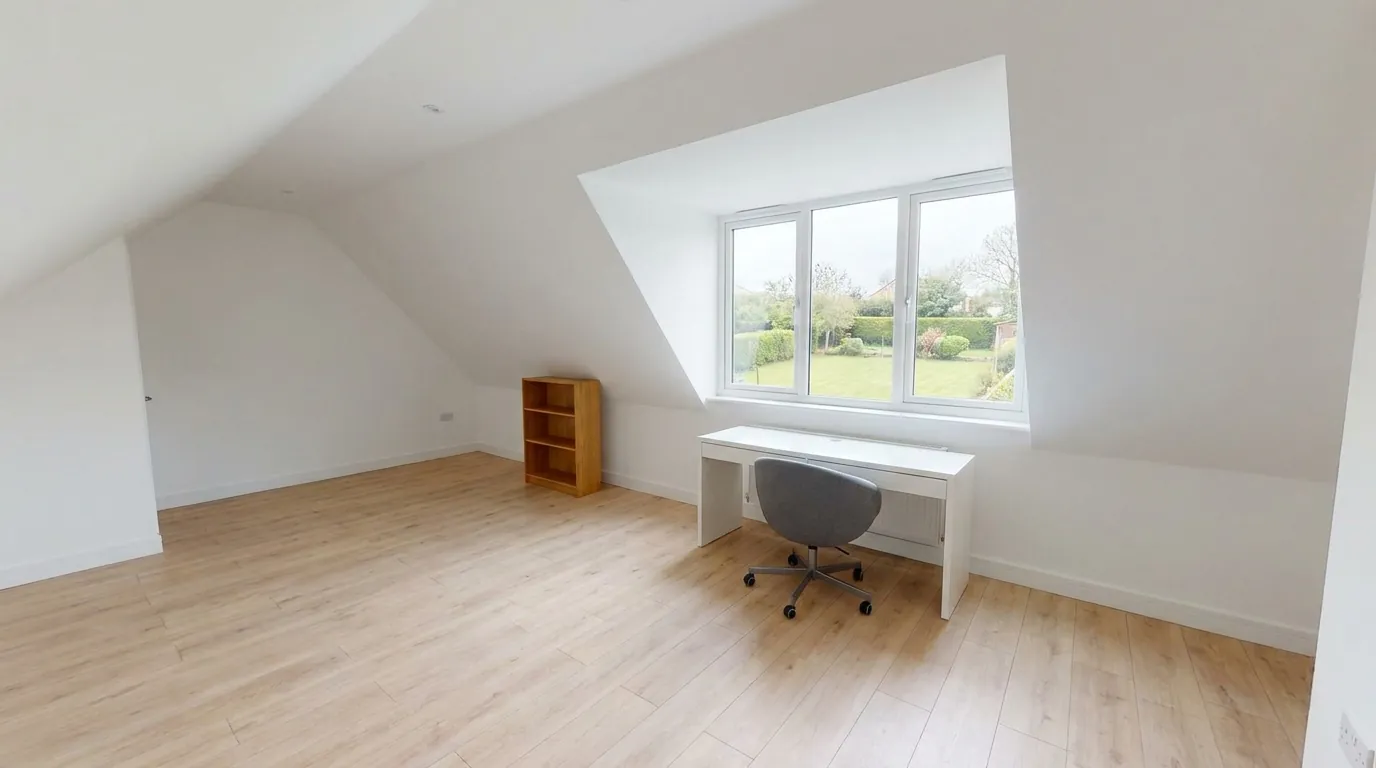
Velux (Rooflight) Conversion
A Velux conversion keeps the existing roof shape and slots roof windows into the slope. No new structure pokes out, no dormer box, no change to the roofline. Most of the work is internal: floor strengthening with new joists, a fire-rated staircase, insulation to current Part L standards, plasterboard, electrics and a smoke alarm system tied into the rest of the house.
Typical UK 2026 cost: £20,000 to £35,000 fitted, mid-spec.
Per square metre: £920 to £1,200.
Build time on site: 4 to 6 weeks.
Suits: houses with a steep existing roof pitch (over 35 degrees) and at least 2.2 m of clear head height down the centre line. Common on detached houses with generous lofts, period properties with tall roofs, and chalet bungalows. Less suitable for trussed roofs on 1970s and 1980s estates where head height is tight.
Planning: almost always Permitted Development on a house. The window sits flush with the slope and adds zero volume to the roof. Conservation areas and Article 4 zones are the exception and need a planning application.
Pros: cheapest option, fastest build, lowest disruption, often no planning application needed, minimal scaffolding.
Cons: least usable floor area because the sloping ceilings cut into the room. Only about half the footprint is full-height. It will not give you a master bedroom with an ensuite and walk-in space.
A Velux works best as a study, a teen bedroom, a yoga or hobby room, or a second sitting room. It is the option to choose when the loft is already tall enough to live in and you only need light, insulation and a safe staircase.
Rear Dormer Conversion
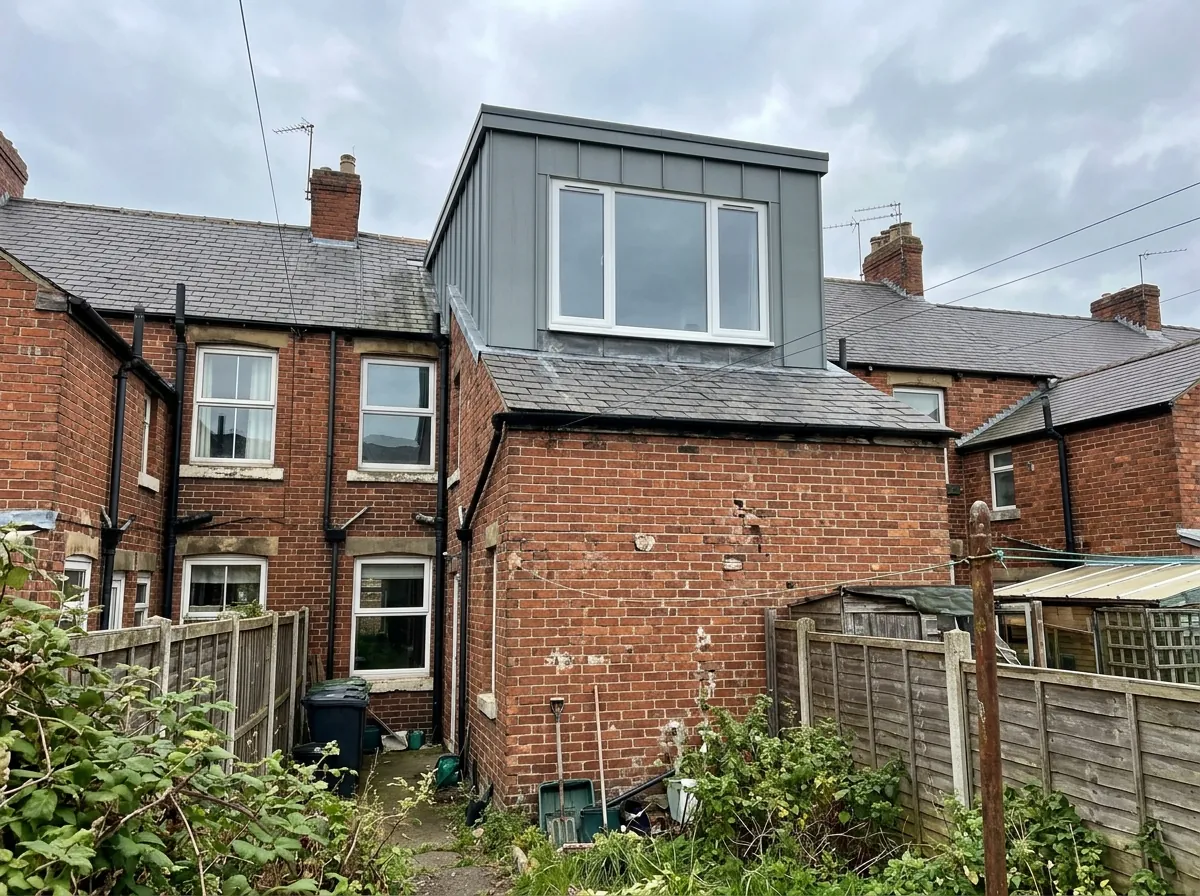
A rear dormer is the workhorse of UK loft conversions and probably accounts for more conversions than every other type combined. A box-shaped structure projects out from the back slope of the roof, lifting the ceiling to full height across most of the footprint and freeing up real usable floor area.
Typical UK 2026 cost: £35,000 to £60,000 fitted, mid-spec.
Per square metre: £1,670 to £2,200.
Build time on site: 8 to 12 weeks.
Suits: Victorian and Edwardian terraces, 1930s semis, modern townhouses, and most standard two-storey houses with a pitched roof and enough roof volume at the rear. The dormer goes on the back so it does not affect the street-facing elevation. This is the type that turns a cold storage loft into a full master bedroom with ensuite.
Planning: usually Permitted Development on a house, provided the new roof volume stays under 40 cubic metres for a terraced house or 50 cubic metres for a semi or detached. Eaves must be maintained, the dormer must sit at least 20 cm back from the original eaves, and the materials need to look similar in appearance to the existing house. Conservation areas, Article 4 directions, flats and maisonettes need full planning permission.
Pros: strong floor area gain (typically 25 to 32 m squared usable), good headroom across about 85 percent of the footprint, generally PD on the rear, sensible build time, strong resale uplift.
Cons: more expensive than a Velux, scaffolding required, party wall agreements needed on terraces and semis, design has to be proportionate or the dormer dominates the rear elevation.
In Newcastle, the rear dormer is the dominant choice in Jesmond and Heaton, where the Victorian and Edwardian terraces line up perfectly for one. Read more on our dormer loft conversion page and Newcastle dormer guide.
L-Shaped Dormer Conversion
An L-shaped dormer is two rear dormers joined at a right angle, normally over the back addition of a Victorian or Edwardian terrace. The main dormer goes over the rear of the principal house and a second smaller dormer goes over the outrigger or back addition. The two combine to form an L when viewed from above and produce one of the most generous loft floorplans you can get on a period terrace.
Typical UK 2026 cost: £45,000 to £65,000 fitted, mid-spec.
Build time on site: 10 to 14 weeks.
Suits: Victorian and Edwardian terraces with a rear back addition (the long thin two-storey wing common in London, Newcastle and most northern industrial cities). The classic Tyneside terrace with a back-addition kitchen below is a prime L-shape candidate. Period townhouses in Jesmond, Heaton and most London zones 2 to 4 are full of them.
Planning: still Permitted Development in many cases if the combined new volume stays under the 40 cubic metre terrace limit. Plenty of L-shapes go over the limit and trigger a full planning application. Always check the cubic content carefully before committing.
Pros: typically gives two bedrooms plus a bathroom in the roof, sometimes three rooms on a wide terrace. Best floor area per pound spent on a Victorian terrace.
Cons: more complex roof geometry, longer build, party wall on both sides of the terrace, often pushes over the PD volume limit.
If you live in a Victorian terrace in Jesmond or Heaton, an L-shape is usually the version of a dormer that gives you the most house for the money. It is also common in London zones 2 to 4.
Hip-to-Gable Conversion
A hip-to-gable conversion is the answer for a hipped roof, the kind that slopes inward on the side as well as the front and back. The sloping side wall is built up vertically to form a full gable end, squaring off the loft and reclaiming the wedge of space the hip was wasting. It is normally paired with a rear dormer for maximum floor area.
Typical UK 2026 cost: £45,000 to £65,000 fitted, mid-spec.
Per square metre: £2,000 to £2,400.
Build time on site: 10 to 14 weeks.
Suits: 1930s semis with hipped roofs, end-of-terrace houses with a hip on the side return, detached homes with hipped roof shapes, and chalet bungalows. The classic example in Newcastle is the 1930s semi-detached in Gosforth, where almost every street has the same hipped roof profile.
Planning: Permitted Development on detached and semi-detached houses if the volume rules are met (50 cubic metres). Conservation areas, flats and Article 4 zones still need planning. End-of-terrace hip-to-gables often need planning because the side elevation is visible from the highway.
Pros: unlocks the most floor area from a hipped roof, gives a full square footprint upstairs, strong value uplift on 1930s semis, full-height ceilings across most of the loft.
Cons: substantial structural work to rebuild a roof slope into a vertical wall, longer build, more scaffolding, side elevation looks different afterwards which can take adjustment.
For a 1930s semi in Gosforth or a similar property in Whitley Bay, this is almost always the right type. See our Newcastle hip-to-gable page for street-level pricing in the area.
Mansard Conversion
A mansard rebuilds the entire roof. The rear wall is taken up almost vertical (the standard angle is 72 degrees), the front gets a steep slope, and the roof becomes a near-flat new ceiling. The result is effectively a whole new storey with full-height walls on every side. It is the most spacious conversion you can do and the most expensive.
Typical UK 2026 cost: £55,000 to £85,000 fitted, mid-spec. Inner London regularly tops £100,000.
Per square metre: £2,170 to £2,800.
Build time on site: 12 to 16 weeks.
Suits: Georgian and Victorian terraces in London and other historic cities, period townhouses, properties in conservation areas where a dormer would look wrong, and homes where the owner wants the maximum possible floor area regardless of cost. Common in inner London, Bath, Edinburgh New Town, and conservation parts of Tynemouth.
Planning: always required. A mansard rebuilds the roofline so it never qualifies as Permitted Development. In conservation areas the design has to match the surrounding rhythm of roofs and is often refused without a heritage statement and careful sash window detail. Flats need planning by default. Listed buildings need Listed Building Consent on top.
Pros: maximum floor area (35 to 48 m squared usable), full-height ceilings across about 95 percent of the footprint, can deliver two large bedrooms plus an ensuite, the highest absolute value uplift, often the only sympathetic option in a historic terrace.
Cons: most expensive option, longest build, planning is never guaranteed, scaffolding wraps the whole house for months, and you are exposed to weather risk during the rebuild.
See our mansard loft conversion page for current planning success rates by London borough, and the Newcastle mansard page for the rare Newcastle situations where a mansard makes sense (mostly Tynemouth seafront and a few period streets in Jesmond).
Comparison Table: All Five Types Side by Side
| Type | UK 2026 cost | Build time | Floor area added | Planning |
|---|---|---|---|---|
| Velux (rooflight) | £20,000 to £35,000 | 4 to 6 weeks | 12 to 18 m squared | PD on houses |
| Rear dormer | £35,000 to £60,000 | 8 to 12 weeks | 25 to 32 m squared | Usually PD |
| L-shaped dormer | £45,000 to £65,000 | 10 to 14 weeks | 30 to 40 m squared | Often PD, sometimes planning |
| Hip-to-gable | £45,000 to £65,000 | 10 to 14 weeks | 28 to 38 m squared | Usually PD on semis |
| Mansard | £55,000 to £85,000 | 12 to 16 weeks | 35 to 48 m squared | Always required |
Per square metre comparison: Velux £920 to £1,200, dormer £1,670 to £2,200, hip-to-gable £2,000 to £2,400, mansard £2,170 to £2,800.
Building Regulations apply to every type without exception. Typical Building Control fees run £500 to £900 in 2026 across most English councils, including the three that cover Newcastle and North Tyneside.
Party Wall agreements are standard on terraces and semis. Budget £700 to £1,200 per affected neighbour for surveyor fees, more if a neighbour appoints their own.
For a deeper look at the cost build-up by line item, see our loft conversion cost guide. For the planning detail and the appeal process, see our loft conversion planning permission guide.
Regional Cost Variation in 2026
Loft conversion prices vary by region more than most homeowners expect. A rear dormer that costs £42,000 in Newcastle costs £62,000 in inner London for the same specification. Labour rates, scaffolding hire, skip licences, parking suspensions and the local availability of structural steel all push prices in different directions.
Using a rear dormer as the baseline, here is how the UK splits in 2026:
- London and the South East: £52,000 to £75,000 (plus 25 to 40 percent on UK average).
- Midlands: £40,000 to £55,000 (matches UK average).
- North West and Yorkshire: £37,000 to £52,000 (minus 7 percent).
- North East (Newcastle, Gateshead, Sunderland): £35,000 to £48,000 (minus 12 percent).
- Scotland: £38,000 to £53,000 (minus 5 percent).
Newcastle and the wider North East genuinely have some of the most competitive loft conversion pricing in the UK. The local trades base is strong, scaffolding hire is cheaper than in the South, and the housing stock (Victorian terraces in Heaton and Jesmond, 1930s semis in Gosforth, seaside townhouses in Tynemouth and Whitley Bay) lends itself to standard dormer and hip-to-gable designs that contractors quote competitively. Our Newcastle cost page has the street-level detail.
For pricing in other major cities, see Manchester, Birmingham and Leeds.
How to Choose the Right Type for Your House
Start with three questions: what is the existing roof shape, how much head height do you have, and what does the council allow?
Roof shape decides the obvious candidate. A hipped roof on a 1930s semi points to hip-to-gable. A Victorian terrace with a back addition points to L-shaped dormer. A standard pitched roof on a 1960s house points to rear dormer. A tall existing loft on a detached house with steep pitch points to Velux. A period terrace in a conservation area points to mansard.
Head height decides feasibility. Stand in the middle of the loft and measure from floor to ridge. Under 2.2 m, you almost certainly need a dormer, hip-to-gable or mansard to lift the ceiling. Over 2.5 m, a Velux becomes viable.
The council decides the paperwork. Three councils cover the Newcastle area: Newcastle City Council for NE1 to NE7 and NE15, North Tyneside Council for NE25 to NE30 (including Tynemouth and Whitley Bay), and Gateshead Council for NE8 to NE11. Each has slightly different conservation area boundaries and Article 4 directions. Before you commit to a type, check whether your postcode falls inside one of those zones. Our Newcastle planning permission page has the up to date map.
Return on investment is broadly similar across the types. A well-executed loft conversion adds 15 to 25 percent to a UK home value. On a £350,000 house, a £45,000 to £55,000 conversion typically delivers £60,000 or more in valuation uplift. The Velux gives the best percentage return because the cost is so low. The mansard gives the biggest absolute pound figure because it creates the most space.
If you would like a written quote on your house, we offer a free home survey and follow it up with a quote itemised by stage. Every project we deliver carries a 10 year workmanship warranty.
Before you book
Frequently asked questions
Which loft conversion type is cheapest in the UK in 2026?
A Velux (rooflight) conversion is the cheapest at £20,000 to £35,000 fitted in 2026. It keeps the existing roof shape and adds windows rather than new structure, which cuts both build time and material cost. It only works if you already have enough head height in the loft (over 2.2 m down the centre line) and a steep enough roof pitch to make the ceilings usable.
Which loft conversion gives the most usable space?
A mansard gives the most usable space, typically 35 to 48 m squared of full-height floor area with ceilings across about 95 percent of the footprint. It rebuilds the entire roof to create what is effectively a whole new storey. The trade-off is cost (£55,000 to £85,000 across most of the UK, often over £100,000 in inner London), a 12 to 16 week build, and full planning permission every time.
Do I need planning permission for a loft conversion?
Many loft conversions on houses fall under Permitted Development and do not need a planning application, provided the new roof volume stays under 40 cubic metres for a terraced house or 50 cubic metres for a semi or detached. Mansards always need planning. Flats, maisonettes, listed buildings, conservation areas and Article 4 zones all need planning regardless of type. Building Regulations approval is required for every loft conversion without exception.
How long does a UK loft conversion take in 2026?
On site, Velux conversions run 4 to 6 weeks, rear dormers 8 to 12 weeks, hip-to-gable and L-shaped dormers 10 to 14 weeks, and mansards 12 to 16 weeks. Add roughly 8 to 16 weeks of design, planning and party wall pre-works at the front end. From first call to occupied room, expect 4 to 8 months in total depending on type and whether you need planning permission.
Which loft conversion suits a 1930s semi-detached house?
A hip-to-gable conversion paired with a rear dormer is the standard answer for a 1930s semi with a hipped roof. The hipped side wall is built up to form a full gable end and a rear dormer adds floor area at the back. The combined cost in 2026 sits around £45,000 to £65,000 in most of the UK, less in the North East. This is the most common loft conversion type in Gosforth and similar 1930s suburbs.
Which loft conversion suits a Victorian terrace?
An L-shaped dormer is the strong choice for a Victorian or Edwardian terrace with a rear back addition. The main dormer goes over the principal house and a smaller dormer wraps over the back-addition kitchen, often giving two bedrooms plus a bathroom in the roof. A standard rear dormer works on terraces without a back addition. Mansards are only the right choice in conservation streets where a dormer would look out of place.
How much value does a loft conversion add to a UK house?
A well-designed loft conversion typically adds 15 to 25 percent to UK home value. On a £350,000 home, that is roughly £52,000 to £87,000 of valuation uplift against a £45,000 to £55,000 build cost. Estate agents in London, Manchester, Leeds, Birmingham and the Newcastle area consistently list converted lofts as one of the strongest value-adding home improvements, particularly when the conversion includes an ensuite.
What is the cheapest region in the UK for a loft conversion?
The North East, covering Newcastle, Gateshead, North Tyneside and Sunderland, is currently the most affordable region for loft conversions in 2026. A rear dormer that costs £52,000 to £75,000 in inner London costs £35,000 to £48,000 in Newcastle for the same specification. Yorkshire, the North West and Scotland sit slightly above the North East. London and the South East are the most expensive by a wide margin.
Related pages
- Cities/Newcastle →
- Cities/Newcastle/Jesmond →
- Cities/Newcastle/Gosforth →
- Cities/Newcastle/Heaton →
- Cities/Newcastle/Tynemouth →
- Cities/Newcastle/Whitley Bay →
- Cities/Newcastle/Dormer →
- Cities/Newcastle/Mansard →
- Cities/Newcastle/Hip To Gable →
- Cities/Newcastle/Cost →
- Cities/Newcastle/Planning Permission →
- Cities/London →
- Cities/Manchester →
- Cities/Birmingham →
- Cities/Leeds →
- Loft Conversion Cost →
- Loft Conversion Planning Permission →
- Dormer Loft Conversion →
- Mansard Loft Conversion →
- Bungalow Loft Conversion →
- How To Convert A Loft →
Ready for a written quote?
Free home survey, a written quote itemised by stage, and a 10 year workmanship warranty.