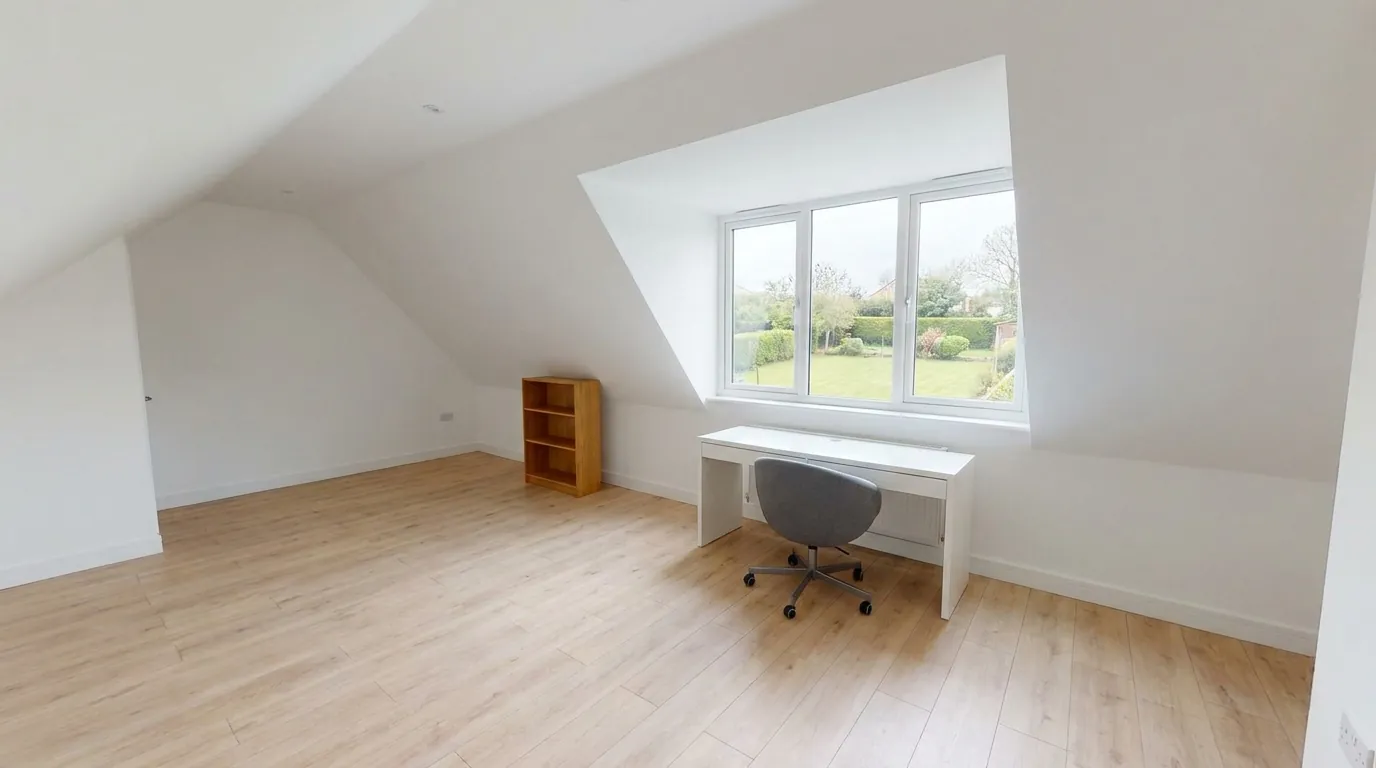
What ROI actually means for a loft conversion
Return on investment for a home extension is the gap between what the build costs and what the finished property is worth on the open market. For a loft conversion in the UK, that gap has held up well through the post-2024 cost cycle because the alternative for a growing family, moving house, has become more expensive and more disruptive. Stamp duty alone on a 500,000 pound replacement home runs into five figures before legal fees, removals, and the cost of swapping schools.
The Nationwide and Halifax research that gets quoted in property pages puts the typical loft uplift at 15 to 25 percent of the home value, provided the conversion delivers a proper double bedroom and, ideally, an en-suite. The figure assumes the work is signed off under Building Regulations, carries a 10 year workmanship warranty, and is built to a written quote that is itemised by stage.
The key word is typical. A 600,000 pound semi in Gosforth that gains a 60,000 pound dormer is in a very different investment case to a 200,000 pound terrace in Sunderland gaining the same room for 40,000 pounds. The maths depends entirely on the local market.
Cost vs value by property tier (illustrative 2026 examples)
Below are four hypothetical scenarios using current UK 2026 cost averages and a 20 percent uplift assumption, which sits in the middle of the typical range. These are illustrative figures to help you sense-check your own situation rather than a quote for any specific home.
Tier 1: 250,000 pound terrace (North East or Yorkshire)
- Rear dormer cost: 37,000 to 48,000 pounds
- Value uplift at 20 percent: around 50,000 pounds
- Net position: roughly break-even to modest gain
- Risk: ceiling price for the street is the binding constraint. If three-bed terraces in the postcode top out at 290,000 pounds, the conversion will not push the value past that cap.
Tier 2: 350,000 pound semi (Midlands or outer Newcastle)
- Rear dormer cost: 40,000 to 55,000 pounds
- Value uplift at 20 percent: around 70,000 pounds
- Net position: 15,000 to 30,000 pound gain on paper
- This is the sweet spot. A 1930s Gosforth semi with a hipped roof is the textbook example, where a hip-to-gable conversion adds a master suite and lifts the home into a different bracket on Rightmove.
Tier 3: 450,000 pound townhouse (Tynemouth, Leeds, Manchester suburbs)
- Dormer or L-shape cost: 45,000 to 65,000 pounds
- Value uplift at 20 percent: around 90,000 pounds
- Net position: 25,000 to 45,000 pound gain
- Coastal and conservation postcodes can push this higher because the comparable sales above 500,000 pounds are well-established.
Tier 4: 600,000 pound period home (inner London, Jesmond, prime Edinburgh)
- Mansard cost: 70,000 to 110,000 pounds (often higher in central London)
- Value uplift at 20 percent: around 120,000 pounds
- Net position: 10,000 to 50,000 pound gain, with wider variance
- High-spec finishes are expected here, and a basic dormer will be marked down by buyers. The ROI is still positive but more sensitive to build quality.
Regional differences across the UK
The same rear dormer costs very different amounts depending on where the scaffolding goes up. UK 2026 averages by region:
- London and South East: 52,000 to 75,000 pounds for a rear dormer. Roughly 25 to 40 percent above the UK average.
- Midlands: 40,000 to 55,000 pounds, which sits at the UK average.
- North West and Yorkshire: 37,000 to 52,000 pounds, around 7 percent below average.
- North East (Newcastle, Gateshead, Sunderland): 35,000 to 48,000 pounds, roughly 12 percent below average.
- Scotland: 38,000 to 53,000 pounds, around 5 percent below average.
London homeowners pay more in absolute terms, but the value uplift is also larger in cash, because a 20 percent gain on a 750,000 pound home is 150,000 pounds. North East homeowners pay less, and the cash uplift is smaller too. Interestingly, the percentage return on cost can actually be higher in the regions, because labour and materials are cheaper relative to the value gain.
Newcastle in particular splits across three planning authorities. Newcastle City Council covers most NE1 to NE7 and NE15 postcodes. North Tyneside Council covers Tynemouth and Whitley Bay (NE25 to NE30). Gateshead Council handles NE8 to NE11. Each authority has its own fee schedule and timelines, which feeds into the overall build cost.
When ROI turns negative
There are clear scenarios where a loft conversion stops making financial sense.
You hit the street ceiling price. Every postcode has a level at which buyers stop bidding, regardless of how many bedrooms a home has. If your finished property would exceed that ceiling, the surveyor will down-value it on sale and the uplift evaporates. Check sold prices on Rightmove for the last 12 months before you commit.
The loft cannot deliver a true double bedroom. Building Regs require minimum head height (typically 2.2 metres at the ridge over usable floor area) and compliant stair access. A small Velux conversion that produces a study or hobby room will add some value, but nowhere near the 20 percent range, because most of the resale uplift comes from genuine extra bedrooms.
You plan to sell within 12 to 24 months. Construction and selling costs eat the margin on a short hold. Stamp duty on the next home, agent fees, and the inevitable settling-in spend after a build all chip away at the paper gain.
You borrow at high interest rates. A 50,000 pound build financed over five years at 8 percent adds roughly 11,000 pounds of finance cost. That comes straight off the ROI. For homeowners avoiding interest-based borrowing, equity release through a remortgage is not always the answer either, and cash, savings, or a phased build can work better.
The build is in a conservation area without realistic planning. Conservation areas, Article 4 zones, and listed buildings all need full planning permission and often refuse rear dormers outright. A Velux-only scheme on a constrained roof may not generate enough usable space to justify the cost.
Tax: the Private Residence Relief advantage
One of the strongest reasons a loft conversion outperforms most other investments on a like-for-like basis is the tax treatment. When you sell your main home in the UK, Private Residence Relief from HMRC usually means no Capital Gains Tax is due on the sale, including the portion of the gain that came from the loft conversion.
Compare that to a buy-to-let, where CGT bites on the uplift, or to a stocks ISA which is capped at 20,000 pounds per year of contributions. A 50,000 pound loft spend that becomes a 70,000 pound value gain on your only home is, in cash terms, a tax-free uplift.
The relief is not automatic in every case. CGT can apply if the property was let, used partly for business, or held as a second home for any period. The rules also tighten if you have more than one residence. Anyone relying on this for a specific decision should check the current HMRC Private Residence Relief guidance or speak to a qualified accountant, because tax rules shift with most Budgets.
How to protect the return
A few practical steps keep the ROI on the right side of the line.
- Get a written quote itemised by stage so you can see exactly what is included. Open-ended contracts are where budgets drift by 20 percent.
- Insist on a 10 year workmanship warranty from the contractor and get it in writing.
- Use a free home visit at the quote stage to confirm head height, joist condition, and stair routing before signing anything. The written quote follows once the loft has been surveyed.
- Check Permitted Development before paying for planning. Most rear dormers on terraces stay under the 40 cubic metre allowance, and most semis sit inside the 50 cubic metre limit. Flats, conservation areas, and Article 4 zones always need permission.
- Budget for Building Regs fees of 500 to 900 pounds and party wall agreements where applicable for terraces and semis.
- Match the spec to the street. Spending 90,000 pounds on a mansard above a 350,000 pound semi tends to overshoot the market, and fitting a budget dormer onto a 600,000 pound townhouse leaves value on the table when buyers compare finishes.
Before you book
Frequently asked questions
Does a loft conversion really add 15 to 25 percent to a UK home value?
That range is the commonly quoted figure from Nationwide research and major UK estate agents, and it holds up for most three-bed terraces and semis that gain a proper double bedroom plus en-suite. The actual uplift depends on the local ceiling price, the quality of the build, and whether the new room is a true bedroom under Building Regs. In stronger markets the uplift can hit the top of that range. In weaker postcodes it sits at the lower end or below.
Is a loft conversion subject to Capital Gains Tax when I sell?
If the property is your only or main residence for the whole period you owned it, Private Residence Relief usually means no CGT is due on the sale, including any uplift from the loft conversion. CGT can apply on second homes, buy-to-lets, or properties used partly for business. Check the current HMRC guidance or speak to an accountant before relying on this for a specific situation.
When is a loft conversion a bad financial decision?
When the build cost plus a sensible contingency would push the finished property above the ceiling price for the street, the return shrinks fast. It is also weak if the loft cannot deliver a proper double bedroom with compliant head height and stair access, because the market tends to pay for usable bedrooms rather than awkward attic space. Short ownership horizons and high-interest borrowing eat into the return as well.
How long does a UK loft conversion take in 2026?
A Velux conversion runs 4 to 6 weeks. A rear dormer is typically 8 to 12 weeks. Hip-to-gable jobs take 10 to 14 weeks, and a mansard 12 to 16 weeks. Planning permission, party wall agreements, and supply chain delays can stretch any of these, so treat the build window as guidance rather than a date set in stone.
Do loft conversions cost less outside London?
Yes. A rear dormer that costs 52,000 to 75,000 pounds in London and the South East typically runs 40,000 to 55,000 pounds in the Midlands and 35,000 to 48,000 pounds across the North East. Labour rates, scaffolding, and skip costs all sit lower in Newcastle, Gateshead, and Sunderland than in inner London.
Do I need planning permission for a loft conversion in Newcastle?
Most rear dormers and Velux conversions on houses fall under Permitted Development if you stay inside the 40 cubic metre allowance for terraces or 50 cubic metres for detached and semi-detached homes. Flats, conservation areas, Article 4 zones, and mansards always need full planning permission. Building Regulations approval is required for every loft conversion regardless of planning route.
Related pages
Ready for a written quote?
Free home survey, a written quote itemised by stage, and a 10 year workmanship warranty.