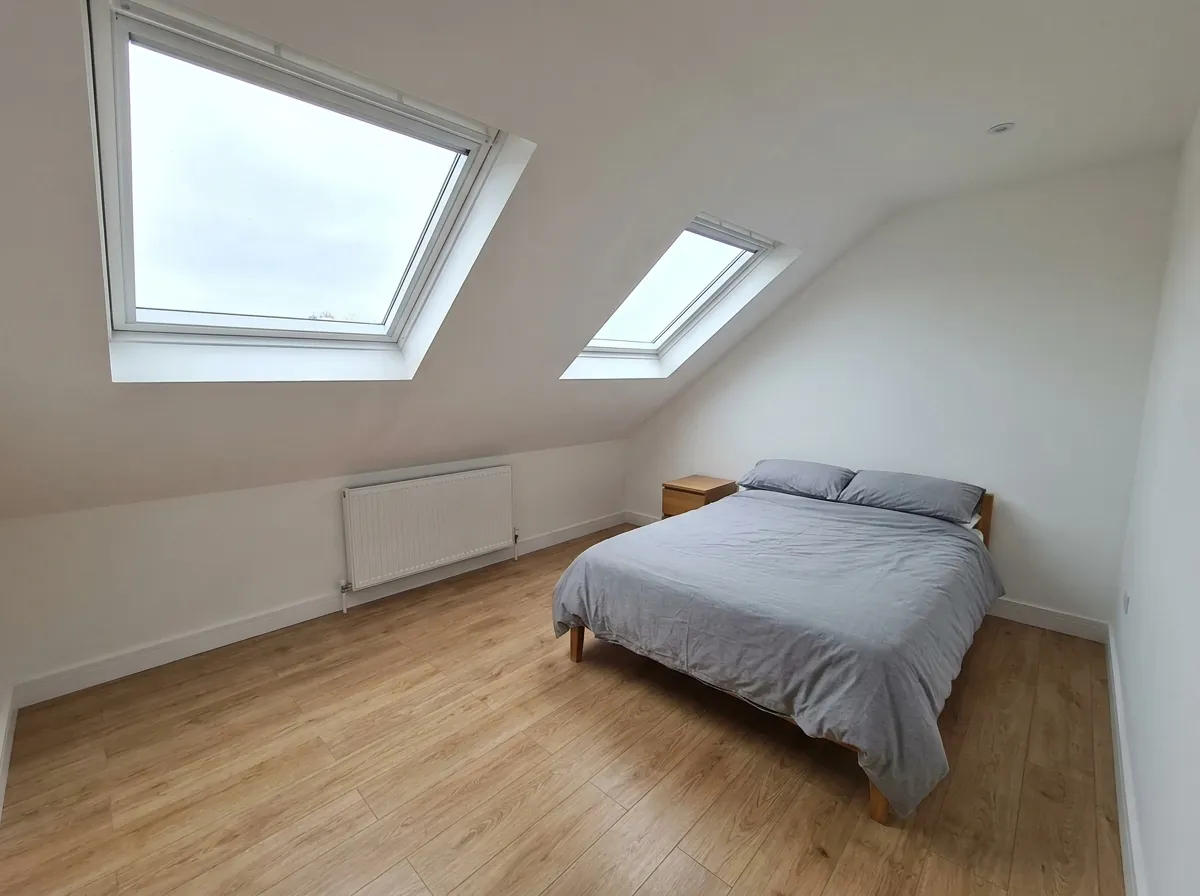
What a Velux Loft Conversion Actually Is
A Velux conversion, sometimes called a rooflight conversion, leaves the roof structure untouched. Builders strengthen the joists, insulate between and under the rafters, board out the floor, fit a staircase, plaster the walls, and cut in Velux-brand rooflights along the existing roof slope. The roof shape stays as it is. No dormer box gets added, the hip is left alone, and there is no mansard rebuild.
Because nothing about the roof shape changes, the project is mostly internal work. That is why it is the cheapest route into the loft and the fastest to finish. It also means you keep every brick and tile you already have, which planners like and neighbours rarely object to.
The downside is floor space. You only get usable floor where the ceiling is high enough to stand under. Anywhere the rafters slope down to the eaves, that space becomes storage at best. A dormer or hip-to-gable adds full-height volume by changing the roof shape, whereas a Velux conversion accepts the geometry you already have and works inside it.
UK 2026 Cost: £20,000 to £35,000
Velux loft conversions run £20,000 to £35,000 across most of the UK in 2026, mid-spec, fully fitted. That works out at roughly £920 to £1,200 per square metre of finished floor area. Compared with a rear dormer at £35,000 to £60,000 or a mansard at £55,000 to £85,000, the saving is real.
What sits inside that price:
- Structural work: new floor joists, steels if the span needs them, strengthening to take a bedroom load
- Insulation to current Building Regs (rafter and floor)
- Staircase build and the loss of a small area on the floor below
- Plastering, electrics, lighting, sockets
- Rooflights, typically three to five Velux units depending on roof size
- A small en-suite if there is plumbing nearby (add roughly £4,000 to £7,000)
- Building Control fees of £500 to £900
What usually pushes a quote toward the £35,000 end: a difficult staircase landing, a deeper en-suite, premium glazing on the Velux units, or a roof that needs partial re-tiling around the new openings.
London and the South East run 25 to 40 percent above these national figures. Newcastle, Gateshead, and the wider North East tend to come in around 12 percent below. A Newcastle Velux conversion in 2026 commonly lands between £18,000 and £30,000.
Head Height: The Rule That Decides Everything
Before anything else, measure from the top of the existing ceiling joists to the underside of the ridge. You need at least 2.3m for a Velux conversion to make sense. Once you add a new floor build-up and insulation under the rafters, you lose around 200 to 250mm of that height. A 2.3m ridge gives you a finished ceiling close to 2.0m at the highest point, which is the minimum for a usable room.
If your ridge sits at 2.2m or lower, a Velux conversion gives you a room you have to stoop in. That is the moment to think about a rear dormer, which raises the internal ceiling by lifting the roof outward, or a hip-to-gable on a semi or detached with a hipped end.
A quick rough check: stand a tape measure in the centre of your loft from the floor joist to the ridge timber. If you read below 2.3m, Velux is the wrong tool for the job. At 2.3m to 2.5m it works for one decent room. Above 2.5m you have proper headroom and a Velux often delivers a room that feels as good as a dormer for two-thirds of the price.
Planning: Usually Permitted Development
On most UK houses, a Velux conversion sits inside Permitted Development. You are not adding volume to the roof, you are putting windows in the existing slope. That means no formal planning application in the majority of cases.
The rules to check:
- The rooflights must not project more than 150mm above the existing roof plane
- They must not sit higher than the ridge
- On a side elevation facing a highway, obscure glazing is normally required and the window must be non-opening below 1.7m from the floor
- You still need Building Regulations approval. Always. Fees run £500 to £900 and the inspector will check structure, insulation, fire escape, and stairs
Permitted Development does not apply if your house is in a conservation area, has an Article 4 direction in force, or is a flat or maisonette. Listed buildings need Listed Building Consent on top of anything else. In all those cases you submit a planning application and wait the standard eight weeks.
Newcastle has three planning authorities to be aware of. Newcastle City Council covers NE1 to NE7 and NE15. North Tyneside Council handles NE25 to NE30, which includes Whitley Bay and Tynemouth. Gateshead Council covers NE8 to NE11. The PD rules are national but each council interprets conservation area boundaries differently, so always check the postcode on the council planning portal before assuming you are clear.
For terraced houses, a Party Wall Agreement with both neighbours is normal even on a Velux job, because the new floor joists usually bear on the party wall.
Build Time: 4 to 6 Weeks
From scaffold up to handover, a Velux conversion runs four to six weeks for a typical mid-terrace or semi. That compares with eight to twelve weeks for a dormer and twelve to sixteen for a mansard.
A rough week-by-week:
- Week 1: scaffold, strip insulation, lift floorboards, install new floor joists and any steel beams
- Week 2: cut openings for rooflights, fit Velux units, weatherproof, first fix electrics and plumbing
- Week 3: insulation, plasterboard, staircase install, Building Control structural inspection
- Week 4: plaster skim, second fix electrics, decoration begins
- Week 5: flooring, doors, final fix, snagging, Building Control sign-off
- Week 6: completion certificate issued, handover
Less disruption matters here. The roof stays watertight throughout, so the rest of the house keeps working. Most homeowners stay put for the whole build. Compare that with a dormer where the roof is open for a week or more and you understand why a lot of families pick Velux even when they could afford the dormer.
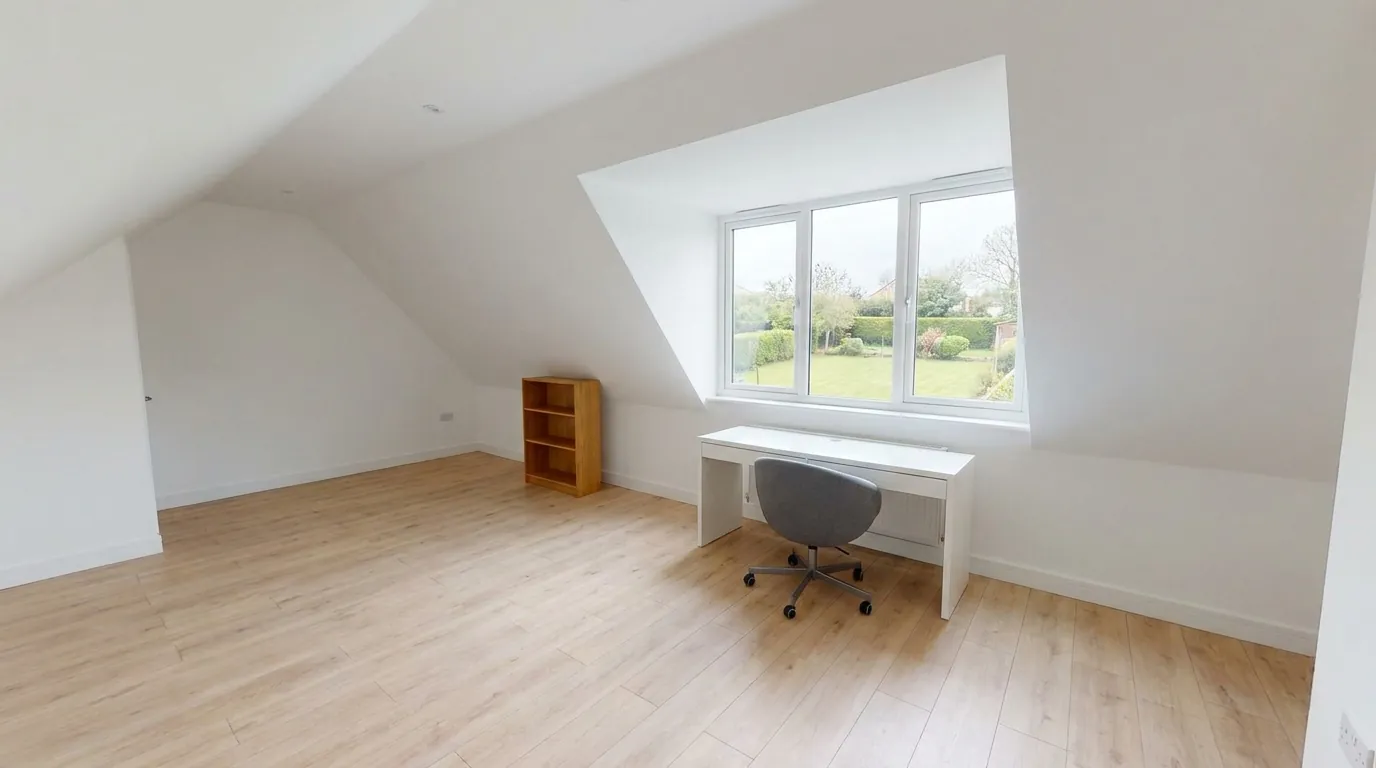
When Velux Is Right vs When to Upgrade to a Dormer
Velux is the right choice when:
- Ridge height is comfortably above 2.3m, ideally 2.5m or more
- You want one room rather than a master suite with en-suite and dressing area
- Budget caps below £35,000
- The property is in a conservation area where dormers face refusal but rooflights pass
- You are selling within three to five years and want the cheapest route to add a bedroom on the EPC
- The roof faces a direction that brings useful daylight (south, east, or west slopes)
Dormer is the better call when:
- Ridge height is borderline or below 2.3m
- You want a proper master bedroom with en-suite and standing room across most of the floor
- The loft will be the main bedroom long term and you need wardrobe walls at full height
- The roof slope is shallow, which makes Velux floor space tiny even with good ridge height
- Resale value matters more than build cost and a dormer adds noticeably more square metres
The 15 to 25 percent home value uplift figure you see quoted for loft conversions applies to both. On a £350,000 house, that is £52,000 to £87,000 added. A Velux at £25,000 and a dormer at £45,000 can both make financial sense, though the dormer adds more livable space and usually a bigger valuation jump. The question is whether the extra £20,000 buys you a room you will actually use, or just a bigger room you will heat.
Newcastle, Jesmond, Gosforth: What Works Where
Different Newcastle housing stock suits different conversion types, and Velux fits some better than others.
Jesmond (NE2) has rows of tall Victorian and Edwardian terraces with steep pitched roofs and generous ridge heights. Velux conversions work well here when the loft has not already been converted by a previous owner, and conservation area coverage means rooflights are often the only route a planner will accept. Check the Jesmond Conservation Area boundary carefully on the Newcastle City Council planning portal.
Gosforth (NE3) is dominated by 1930s semis with hipped roofs. Ridge heights are usually fine, but the hipped corners cut into usable floor area on a pure Velux. Many Gosforth owners go hip-to-gable instead to reclaim that volume. Velux still works for a single-room conversion on a budget.
Heaton (NE6) has a mix of Tyneside flats and Victorian terraces. Tyneside flats need a different approach because the loft sits above the upper flat rather than a single house, and that opens leasehold and shared roof questions. Standard terraces in Heaton suit Velux when ridge height permits.
Tynemouth (NE30) and Whitley Bay (NE25, NE26) sit under North Tyneside Council. The Victorian and Edwardian seaside townhouses in Tynemouth have the height for Velux. Whitley Bay's 1930s semis often need a hip-to-gable for the same reasons as Gosforth.
For a full local cost breakdown including Building Control fees specific to each council, see our Newcastle cost page.
What You Get From UK Loft Conversion
We build Velux conversions across the UK. For every quote we deliver:
- Free home survey including a proper head height check before anyone talks numbers
- Written quote after the survey, itemised by stage so you can see exactly what is included
- 10 year workmanship warranty on the finished work
- Building Control liaison handled by us, not left for you to chase
- Party Wall notices prepared where they are needed for terraces and semis
We will tell you honestly if your ridge height makes Velux a bad fit and a dormer the right answer, even though the dormer costs more. The wrong conversion built cheaply is the most expensive mistake you can make on this kind of project.
Before you book
Frequently asked questions
How much does a Velux loft conversion cost in the UK in 2026?
£20,000 to £35,000 for a typical mid-spec build, fully fitted with Building Control fees included. Per square metre that works out at £920 to £1,200. London and the South East run 25 to 40 percent higher. Newcastle and the wider North East come in around 12 percent below the national average, so £18,000 to £30,000 is normal there.
How long does a Velux loft conversion take to build?
Four to six weeks from scaffold up to handover on a typical terrace or semi. The roof stays watertight throughout, so the rest of the house keeps working and most families stay in the property during the build.
Do I need planning permission for a Velux conversion?
Usually no. Velux conversions sit inside Permitted Development on most UK houses because no volume is added to the roof. You will need planning permission if the property is in a conservation area, has an Article 4 direction, is a flat, or is listed. Building Regulations approval is always required regardless of planning status, with fees of £500 to £900.
What head height do I need for a Velux loft conversion?
At least 2.3m measured from the top of the existing ceiling joists to the underside of the ridge. Below that, the new floor build-up and insulation will leave you with a room you cannot stand up in. At 2.5m or more you get genuine headroom and a Velux often feels as spacious as a dormer.
Is a Velux conversion worth it compared with a dormer?
Yes if your ridge is comfortably above 2.3m and you want one good room on a budget. A dormer adds more usable floor area by changing the roof shape, so it is the better choice for a master suite or if the loft will be your main bedroom long term. A dormer costs roughly £15,000 to £25,000 more for that extra volume.
Will a Velux conversion add value to my house?
Loft conversions typically add 15 to 25 percent to home value in the UK. On a £350,000 house that is £52,000 to £87,000 of uplift against a £20,000 to £35,000 build cost. The uplift on a Velux is usually a few percentage points lower than a dormer because the floor area added is smaller, though the build cost is also lower.
Can I have an en-suite in a Velux loft conversion?
Yes, if the floor area allows and there is a soil stack within reasonable reach. Adding a small en-suite costs an extra £4,000 to £7,000 on top of the base conversion price. The tighter floor plan of a Velux means the en-suite is usually a shower room rather than a full bathroom.
Do I need a Party Wall Agreement for a Velux conversion?
For a terraced house or semi, almost always yes, because the new floor joists usually bear on the party wall. Notices must be served at least two months before work starts. Detached houses generally do not need a Party Wall Agreement.
Related pages
- Loft Conversion Cost →
- Loft Conversion Types →
- Loft Conversion Planning Permission →
- Dormer Loft Conversion →
- Hip To Gable Loft Conversion →
- Mansard Loft Conversion →
- Cities/Newcastle →
- Cities/Newcastle/Cost →
- Cities/Newcastle/Planning Permission →
- Cities/Newcastle/Velux →
- Cities/Newcastle/Jesmond →
- Cities/Newcastle/Gosforth →
- Cities/Newcastle/Heaton →
- Cities/Newcastle/Tynemouth →
- Cities/Newcastle/Whitley Bay →
- Cities/London →
- Cities/Manchester →
- Cities/Leeds →
- Bungalow Loft Conversion →
- Loft Conversion Building Regulations →
Ready for a written quote?
Free home survey, a written quote itemised by stage, and a 10 year workmanship warranty.