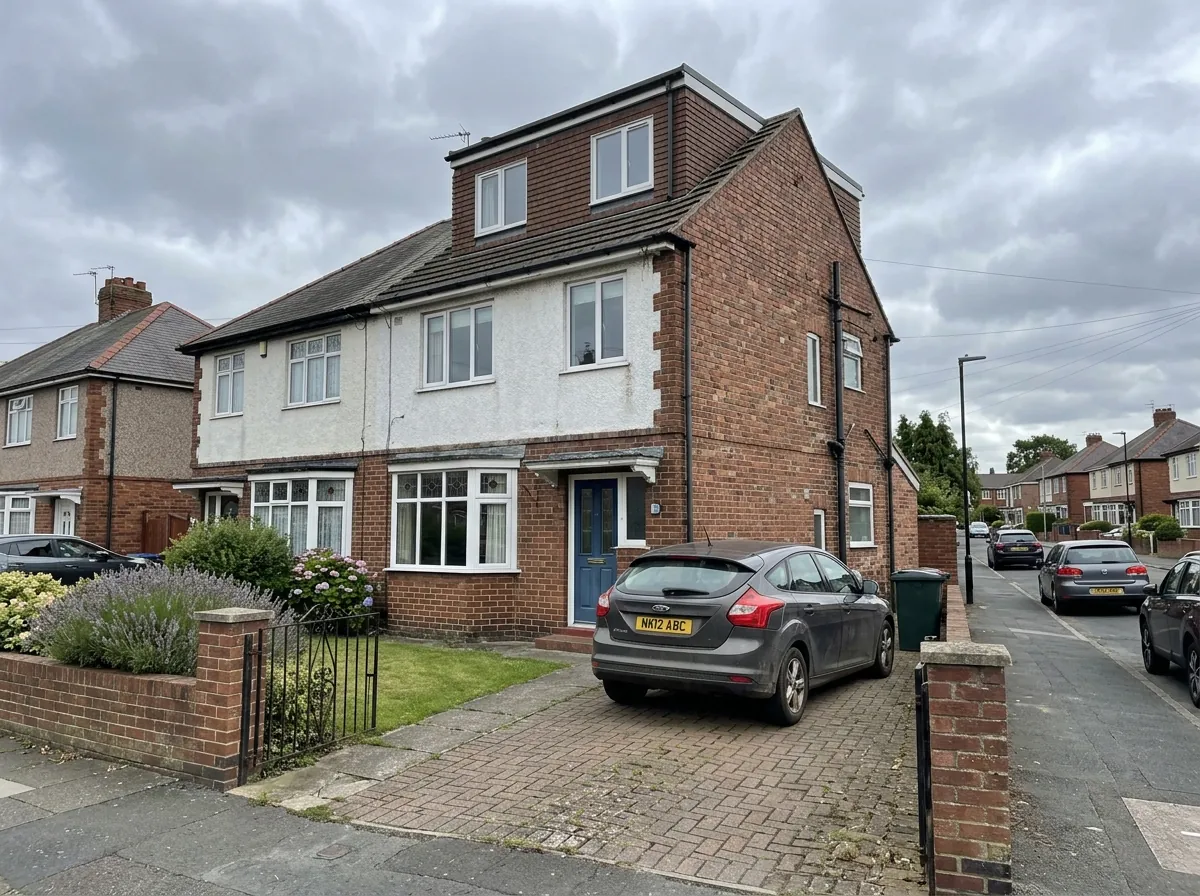
What a hip-to-gable conversion does to a Newcastle semi
On a hipped roof the side slopes inwards above the eaves, so the loft floor at that end is squeezed by low knee walls. A hip-to-gable conversion rebuilds the sloping side as a vertical brick or block gable wall, extending the ridge line out to meet it. You gain around 2 to 3 metres of usable floor width on the side that was previously unusable.
The layout that works best on a 1930s Gosforth semi is the hip-to-gable plus rear dormer combination. The gable opens up the side. The dormer at the back gives full ceiling height across the rear half of the room. Together they turn a cramped loft into a true double bedroom with en-suite, or two smaller bedrooms with a shared shower room.
Typical floor area added in Newcastle on a standard 1930s three-bed semi: 22 to 30 square metres of new habitable space.
Why this type suits the Newcastle housing stock:
- Gosforth NE3 has streets of 1930s hipped semis where the loft is currently dead space
- Kenton, Fawdon and Longbenton share the same roof profile
- Whitley Bay NE25 has parallel rows of 1930s semis with the same hip detail
- Benton and Forest Hall sit in the same bracket
The terrace stock in Heaton and Jesmond is mostly gable-ended already, so those streets do not need hip-to-gable work. A rear dormer or L-shape is the right call there instead. If you are unsure which type fits your roof, the Newcastle loft conversion hub covers all four main options.
Newcastle pricing for a hip-to-gable conversion
Across the North East, hip-to-gable jobs come in cheaper than the UK average. Labour rates in Newcastle, Gateshead and North Tyneside sit roughly 12 percent below the national mid-point. Material costs are broadly the same as the rest of England.
Real pricing bands seen on Newcastle jobs in 2026:
- Hip-to-gable only, basic fit-out, no en-suite: £45,000 to £52,000
- Hip-to-gable plus rear dormer, double bedroom plus en-suite: £52,000 to £62,000
- Hip-to-gable plus L-shaped dormer, two-room layout: £58,000 to £68,000
These figures are fully fitted. They include structural steels, the new gable wall, roof works, insulation to current Building Regs, plastering, second-fix joinery, electrics, plumbing, the staircase and a standard bathroom suite. They assume a mid-spec finish.
What the per-square-metre rate looks like for this type: £2,000 to £2,400 per square metre. That is the second-highest of the four main loft types, behind only mansards. The reason is the structural work involved in rebuilding the side wall and tying it back into the existing roof.
For context on how this compares against other types and other parts of the country, the full UK loft conversion cost guide breaks down the regional and type-by-type spread. The dedicated Newcastle cost page holds the local comparison against dormer, mansard and Velux.
Build time and what to expect on site
A hip-to-gable build runs 10 to 14 weeks on site for a standard Newcastle semi. Add 8 to 13 weeks before that if planning permission is required, which it usually is for this type.
A realistic week-by-week pattern:
- Weeks 1 to 2: scaffold up, strip the hip slates, take down the side of the roof
- Weeks 3 to 4: build the new gable wall in block or brick, install structural steels
- Weeks 5 to 6: form the new roof structure, lay the dormer if part of the spec
- Weeks 7 to 8: roof felt and slate or tile, weather-tight, windows in
- Weeks 9 to 10: first-fix electrics, plumbing, insulation, plasterboard
- Weeks 11 to 12: plastering, second-fix, bathroom
- Weeks 13 to 14: decoration, flooring, snagging, handover
This is messier and louder than a Velux job. The scaffold is up for the full build. The side and rear of the house are open to weather during weeks 3 to 6, so a good contractor sequences the gable and roof works to close the property up as fast as possible.
You can usually stay in the house during the build. The works are above ceiling level for most of the programme. The main disruption windows are the staircase install (usually a 2 to 3 day cut-in on the upstairs landing) and the connection of services.
Planning permission in Newcastle for hip-to-gable
This is the most important section to read before you commit. Hip-to-gable conversions sit awkwardly in the planning system and the rules differ by which of the three Newcastle area councils covers your address.
The national rule. Hip-to-gable enlargements are listed in Schedule 2, Part 1, Class B of the Town and Country Planning (General Permitted Development) Order 2015. They can be done under Permitted Development if the new roof volume stays within 50 cubic metres for a semi-detached or detached house, the works do not extend forward of the original front roof slope, and the property is not on Article 2(3) designated land.
The Newcastle reality. Newcastle City Council's own Household Design Guide states that hip-to-gable extensions will not normally be supported where planning permission is required, because they can make a semi look visually unbalanced and contribute to a terracing effect on the street. In practice this means the council will accept hip-to-gable jobs that genuinely fall under Permitted Development, but a full planning application for one on a prominent corner or in a sensitive area is likely to be refused. Most Newcastle hip-to-gable jobs are designed to stay within Permitted Development limits for this reason.
When you definitely need a full planning application:
- The property is in a conservation area. Parts of Jesmond, Gosforth, Sandyford, Heaton and the City Centre are covered
- The property has an Article 4 Direction removing PD rights for roof enlargements. Northumberland Gardens and Summerhill conservation areas have these in place, and other pockets across the city are covered
- The roof volume exceeds 50 cubic metres including any previous enlargement
- The property is a flat, a maisonette or a listed building
- You are in the Saint Peter's Basin Article 4 area
The three councils. Newcastle is split across three planning authorities. Each runs its own portal and timelines.
- Newcastle City Council covers NE1 to NE7 and NE15, including Jesmond, Gosforth, Heaton and Fenham
- North Tyneside Council covers NE25 to NE30, including Whitley Bay, Tynemouth and Cullercoats
- Gateshead Council covers NE8 to NE11, including Low Fell and Saltwell
For a Whitley Bay 1930s semi you are dealing with North Tyneside Council, not Newcastle City Council. The application process and the local design preferences are different.
Lawful Development Certificate. Even if your job sits within Permitted Development, the council does not automatically confirm that. The recommended step before signing a contract is a Lawful Development Certificate. It costs around £103 and removes any doubt at sale time. Buyers' solicitors routinely ask for one on hipped-roof conversions.
Building Regulations. These apply to every loft conversion regardless of planning status. Expect £500 to £900 in council fees, plus a few site visits from the Building Control surveyor during the build. Fire escape, staircase design, insulation and structural calculations are all covered.
For the detail on permitted development, Article 4 areas and the LDC process, the Newcastle planning permission page and the UK-wide planning guide go further.
Where hip-to-gable works best across Newcastle
The conversion type is roof-specific. It only makes sense if you have a hipped roof to start with. That rules out a lot of central Newcastle and most of the inner suburbs, and steers the demand into specific postcodes.
Gosforth NE3. The strongest candidate area. Streets off Salters Road, around Gosforth High Street and across South Gosforth are dominated by 1930s three-bed semis with hipped roofs. Plot sizes are generous enough for a paired hip-to-gable plus rear dormer build. Local schools and the Gosforth high street make the resale uplift especially strong. See the Gosforth area page for property type detail.
Whitley Bay NE25 and NE26. Park View, Marine Avenue and the streets off Marden Road have the same 1930s semi stock. The North Tyneside planning approach is slightly more relaxed than Newcastle City Council on hipped-roof work outside conservation areas. Coastal salt air means slate or fibre cement is preferred over felt finishes. Full breakdown on the Whitley Bay page.
Kenton, Fawdon, Longbenton. Postwar and late-1930s semis. The roof profile is right. Pricing tends to come in at the lower end of the Newcastle band because plots are simpler and access is easier.
Benton and Forest Hall. Mix of 1930s and 1950s semis. Many already have hipped roofs intact. Worth a structural survey before quoting because some have shallow pitches that limit headroom.
Jesmond NE2. Mostly Victorian terraces with gable ends already. A hip-to-gable is rarely the answer here. The right type is usually a rear dormer or an L-shaped dormer. See the Jesmond page.
Heaton NE6. Tyneside flats and Victorian terraces dominate. As with Jesmond, dormers are the usual answer. See the Heaton area page.
Tynemouth NE30. Victorian and Edwardian seaside townhouses, often three or four storeys already. Hip-to-gable is rare here. Mansards are more common. See the Tynemouth area page.
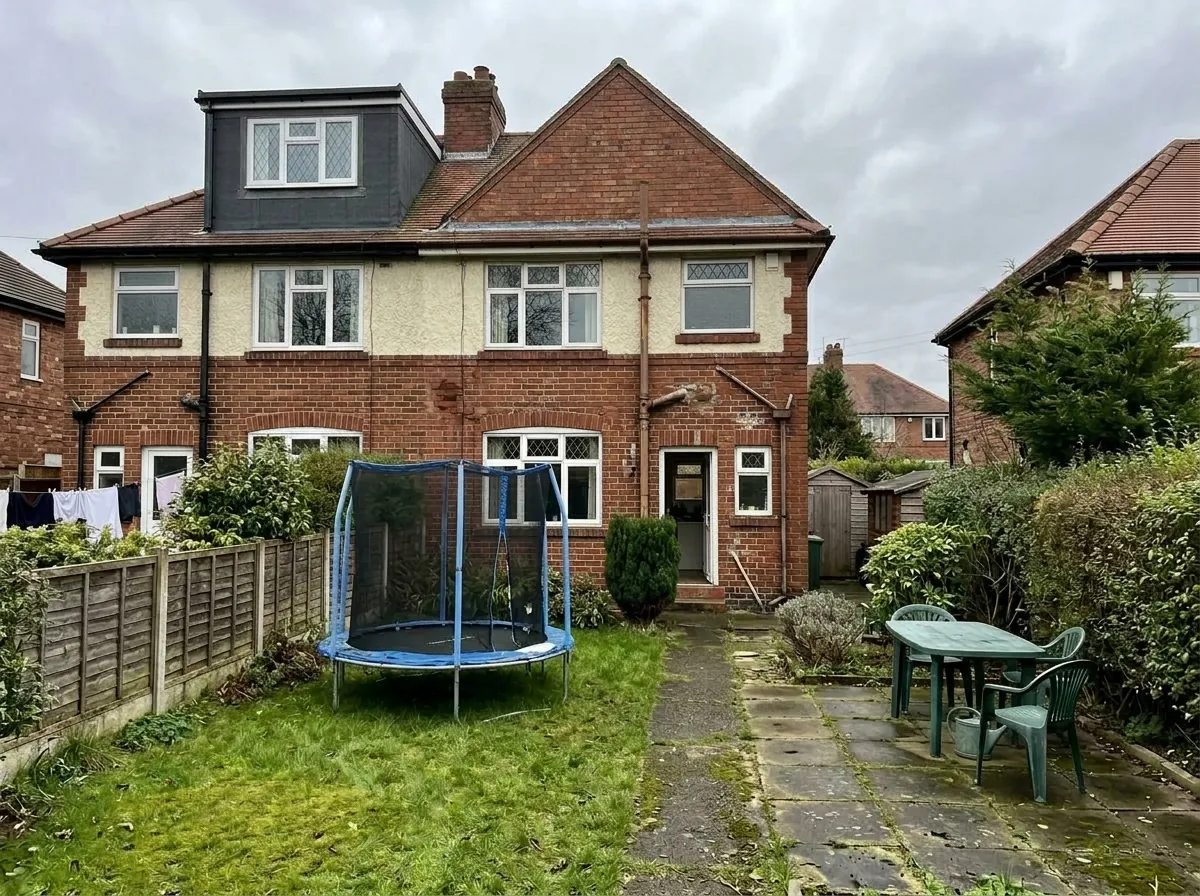
Hip-to-gable on a semi-detached: the party wall question
On a semi the new gable wall is built up on top of, or alongside, the existing party wall with your attached neighbour. This brings the Party Wall etc. Act 1996 into play.
You will need to serve a Party Wall Notice on the adjoining owner at least two months before work starts. The notice describes what you intend to do, includes drawings and gives the neighbour the option to consent in writing or appoint a party wall surveyor.
If they consent, the cost is just the notice itself. If a surveyor is appointed, you are usually liable for both surveyors' fees. That can add £1,500 to £3,500 to the project on a straightforward case.
This is a normal part of every Newcastle hip-to-gable on a semi. A good contractor handles the notice template and timing. The neighbours' real concerns are usually around scaffold position, noise hours and damage cover, all of which the party wall award fixes in writing.
The other consideration on semis is the visual symmetry of the pair. Newcastle City Council's design guide flags hip-to-gable extensions as a concern precisely because one side of a pair can end up much taller than the other. If your neighbour has already converted their loft with a hip-to-gable, your application is far stronger because the pair is being brought back into symmetry. If they have not, expect the planning officer to ask design questions about how the result will look from the street.
Resale uplift and whether the numbers stack up
Loft conversions add 15 to 25 percent to a UK home's value on average. A 1930s Gosforth semi in the £350,000 to £420,000 bracket gains £55,000 to £85,000 in market value from a hip-to-gable plus rear dormer.
At £52,000 to £62,000 invested, the net uplift sits at £3,000 to £33,000 on the day the work finishes. That is before the additional rental value or future capital growth on the larger floor area.
The stronger case is the per-square-metre maths. Buying an extra bedroom in Gosforth or Whitley Bay through a move would mean stamp duty, agent fees and the price gap to the next size bracket up. The conversion route adds the bedroom without the moving costs and keeps you on the school catchment, the commute and the street you already chose.
It is worth getting two written valuations from local estate agents before you start, one based on current floor area and one on the as-converted floor area. Most Newcastle agents will do these free in exchange for a future instruction conversation. The honest number sometimes makes the case for a simpler dormer-only job rather than the full hip-to-gable. Other times it makes the case for going one step further to a mansard for the resale ceiling.
How we quote and what is included
UK Loft Conversion builds across Newcastle, Gateshead and North Tyneside, and hip-to-gable is work we do regularly.
The quote process:
- Phone or web enquiry, brief description of the property and what you want to gain
- Free home survey, including roof inspection and measured drawings
- Free written quote after the visit, itemised by stage
- Architectural drawings and structural calcs prepared if you proceed
- Planning or Lawful Development Certificate application submitted on your behalf
- Build starts once permissions are in place and a programme is agreed
Every completed conversion carries a 10 year workmanship warranty. Building Control sign-off and a Final Certificate are delivered with the keys.
What the written quote covers: scaffold, demolition and waste removal, the new gable wall in block or brick, structural steels, all new roof structure and covering, windows or rooflights, full insulation pack to current regs, plasterboard and skim, staircase, fire-rated doors as required, full first and second fix electrics and plumbing, the bathroom suite and tiling, decoration, flooring and snagging.
What sits outside it and is itemised separately: planning application fee, Building Regs fee, Party Wall surveyor fees if appointed, any kitchen or bedroom furniture, blinds and external decoration of the new gable in matching brick or render.
For an alternative type on the same property, check the Newcastle dormer page and the Newcastle Velux page. For the UK-wide brand and head-term context, see hip-to-gable loft conversion and loft conversion types.
Before you book
Frequently asked questions
How much does a hip-to-gable loft conversion cost in Newcastle?
Typical Newcastle pricing runs £45,000 to £62,000 fully fitted. A hip-to-gable only build with a basic fit-out lands at £45,000 to £52,000. A hip-to-gable paired with a rear dormer, double bedroom and en-suite lands at £52,000 to £62,000. Per square metre this works out at £2,000 to £2,400. The North East is roughly 12 percent below the UK average for this type.
Do I need planning permission for a hip-to-gable conversion in Newcastle?
Most do, in practice. Hip-to-gable enlargements can fall under Permitted Development if they stay within 50 cubic metres total roof volume and meet the other Class B conditions. Newcastle City Council's design guide states that hip-to-gable extensions will not normally be supported where a full planning application is required, so projects are usually designed to stay inside Permitted Development limits. A Lawful Development Certificate is recommended to confirm the status before work starts. Conservation areas in Jesmond, Gosforth, Heaton, Sandyford and the City Centre, plus any Article 4 area, always need a full application.
How long does a hip-to-gable conversion take to build?
On site, 10 to 14 weeks for a standard Newcastle semi. Add 8 to 13 weeks beforehand if planning permission is being sought, and a further 4 to 6 weeks for architectural and structural drawings. Total project length from first call to handover is usually 5 to 8 months.
Will a hip-to-gable work on my Gosforth semi?
Most 1930s Gosforth semis are good candidates. The roof needs to be a true hipped roof with the original timber structure intact. Headroom at the ridge should be at least 2.4 metres so the converted ceiling height comes out above 2.2 metres. A free home survey confirms the roof structure, plot orientation and what layout works.
Do I need a party wall agreement with my neighbour?
Yes, on a semi-detached property. The Party Wall etc. Act 1996 applies because the new gable wall is built up against the existing party wall. A two-month notice is served on the adjoining owner. If they consent in writing, there is no further cost. If they appoint a surveyor, party wall fees usually add £1,500 to £3,500 to the project.
Can I stay in the house during the build?
Yes, in most cases. The work happens above the ceiling line for most of the programme. The disruptive points are the staircase cut-in, which takes 2 to 3 days on the landing, and the connection of services. The scaffold stays up for the full 10 to 14 weeks.
Does a hip-to-gable add value to a Newcastle home?
Yes. Loft conversions add 15 to 25 percent to a UK home's value on average. A 1930s Gosforth or Whitley Bay semi in the £350,000 to £420,000 bracket gains £55,000 to £85,000 in market value from a hip-to-gable plus dormer. At £52,000 to £62,000 invested, the net uplift on completion sits at £3,000 to £33,000, with rental and capital growth benefits on top.
Is hip-to-gable the right choice over a dormer?
It depends on the roof. If you have a hipped roof and a wide loft is the goal, hip-to-gable wins. If you already have a gable end and the roof slopes only at the front and back, a rear dormer is cheaper and faster. Most Newcastle 1930s semis benefit from both done together, the gable for floor width and the dormer for ceiling height.
Related pages
- Cities/Newcastle →
- Cities/Newcastle/Gosforth →
- Cities/Newcastle/Whitley Bay →
- Cities/Newcastle/Jesmond →
- Cities/Newcastle/Heaton →
- Cities/Newcastle/Tynemouth →
- Cities/Newcastle/Dormer →
- Cities/Newcastle/Mansard →
- Cities/Newcastle/Velux →
- Cities/Newcastle/Cost →
- Cities/Newcastle/Planning Permission →
- Loft Conversion Cost →
- Loft Conversion Planning Permission →
- Loft Conversion Types →
- Hip To Gable Loft Conversion →
- Dormer Loft Conversion →
- Cities/Gateshead/Hip To Gable →
- Cities/Sunderland/Hip To Gable →
- Cities/South Tyneside/Hip To Gable →
- Cities/North Tyneside/Hip To Gable →
Ready for a written quote?
Free home survey, a written quote itemised by stage, and a 10 year workmanship warranty.