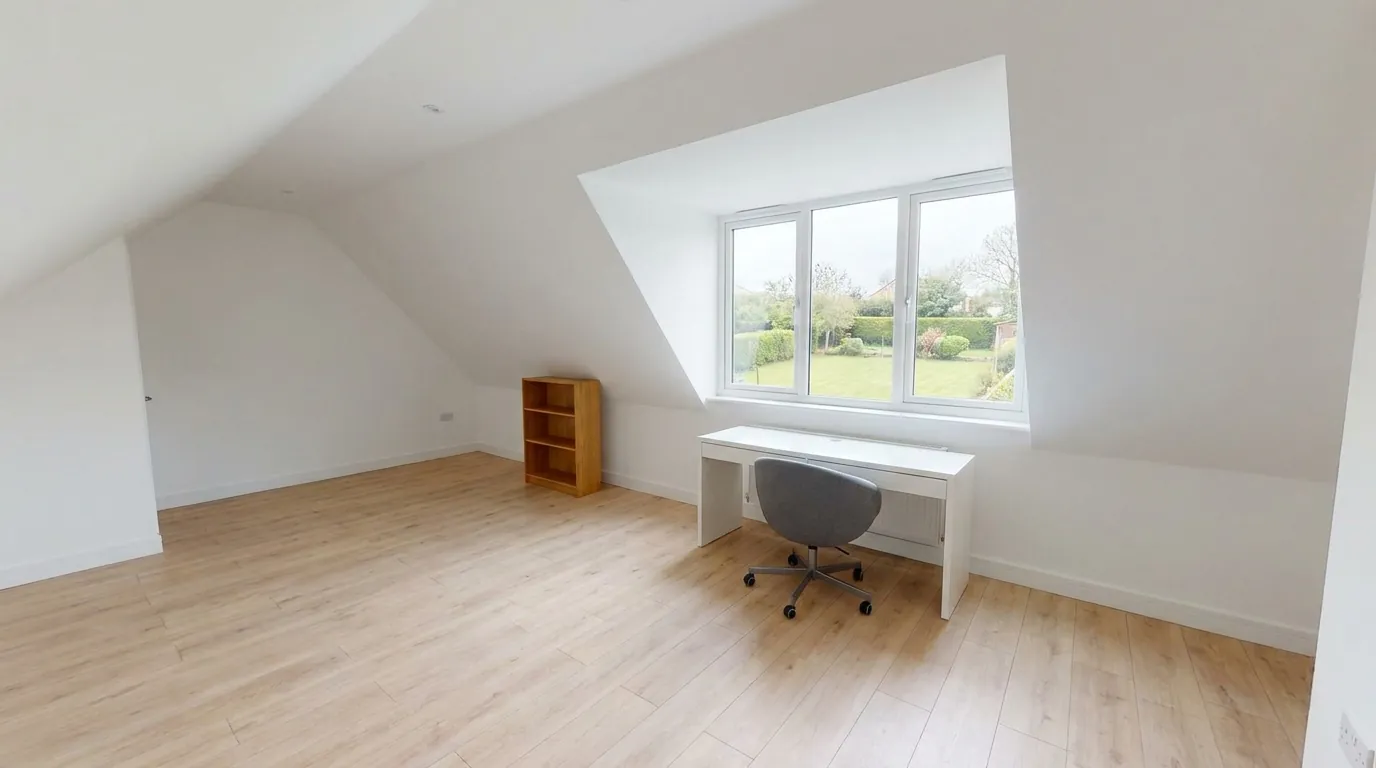
The Full Timeline at a Glance
A standard UK loft conversion runs in three phases. Pre-build covers design, planning, structural drawings, party wall notices, and builder lead time. Build is the noisy stretch when work actually happens on site. Snagging is the quiet two weeks of fixing the last 5%.
Here is what each phase costs you in calendar time:
- Pre-build under Permitted Development: 4 to 8 weeks
- Pre-build with full planning permission: 8 to 14 weeks
- Build, Velux only: 4 to 6 weeks
- Build, rear dormer: 8 to 12 weeks
- Build, hip-to-gable: 10 to 14 weeks
- Build, mansard: 12 to 16 weeks
- Snagging and sign-off: 1 to 2 weeks
Add those up and the realistic range from first survey to handover is 12 to 26 weeks. A simple Velux job in a permitted-development semi can be done in three months. A mansard on a London terrace with conservation area consent and a party wall award can easily run six months.
Phase 1: Pre-Build (4 to 14 Weeks)
This is the phase most homeowners underestimate. Nothing is happening on site, but quite a lot is happening on paper.
Survey and design (1 to 2 weeks). A reputable firm visits, measures, talks through the brief, and produces a free written quote after the home visit.
Architectural drawings (2 to 4 weeks). Plans for planning and for building control are two different sets. Many firms run them in parallel.
Planning route (the big variable).
- *Permitted Development.* Most rear dormers and Velux conversions on houses fall under PD (40 cubic metres for terraces, 50 cubic metres for detached and semi-detached). A Lawful Development Certificate is sensible and takes about 8 weeks at most councils.
- *Full planning permission.* Required for conservation areas, Article 4 zones, flats, mansards, and anything that breaks PD limits. UK councils have a statutory 8-week target. Reality in 2026 is 8 to 12 weeks, sometimes longer in busy boroughs.
Structural calculations (1 to 2 weeks). A structural engineer signs off the steels and floor loadings. This feeds into building control.
Building Regulations (always required). Fees are typically £500 to £900. You can submit a full plans application (around 5 weeks for approval) or use a building notice (faster start, more risk).
Party Wall agreements (2 months minimum). Common for terraces and semis. You serve notice on neighbours, who have 14 days to respond. If they dissent, a surveyor produces an award, which typically takes another 4 to 6 weeks.
Phase 2: The Build (4 to 16 Weeks)
Once the paperwork is settled, the build itself is predictable. The roof type and the conversion style drive the duration.
Velux (rooflight) conversion: 4 to 6 weeks. This is the simplest type of build. The existing roof structure stays. New floor joists go in, insulation, plasterboard, stairs, two or three Velux windows, electrics and a small en-suite. Suitable when the existing head height is already 2.3 metres or so.
Rear dormer: 8 to 12 weeks. The most common UK conversion. The rear roof slope is opened up and a box dormer is built out. Adds significant headroom and usable floor space.
Hip-to-gable: 10 to 14 weeks. Common on 1930s semis (think Gosforth in Newcastle, or any inter-war suburb). The sloping hip is rebuilt as a vertical gable wall, often combined with a rear dormer for an L-shape.
Mansard: 12 to 16 weeks. This is the most disruptive type. The rear roof slope (and sometimes both slopes) is rebuilt at a 72-degree angle. It gives the largest amount of space and the highest cost, and it has the longest build window. Almost always needs planning permission.
Weather plays a role in all of these. The roof comes off at some point. Most established firms tarp and scaffold properly so rain does not stop the job, but a serious storm week can add days.
Phase 3: Snagging and Sign-Off (1 to 2 Weeks)
The build is rarely finished on the day the scaffold comes down. Snagging is the final walk-through where you list every paint touch-up, door catch, skirting gap and silicone bead that is not right. A good builder fixes these inside a week.
Final building control sign-off happens here. The inspector visits, checks fire doors, smoke alarms, escape routes, insulation values, and structural elements. You get a completion certificate which you will need when you sell the house.
Our 10 year workmanship warranty is issued at this point as well.
What Actually Delays Loft Conversions
Six things cause almost every loft conversion overrun.
- Planning refusal or conditions. A flat refusal restarts the clock. An approval with awkward conditions (window obscuring, materials change) can add 2 to 4 weeks.
- Party wall disputes. A neighbour who dissents and refuses to engage can push the start date by 6 to 8 weeks.
- Structural surprises. Rotten joists, undersized rafters, a hidden chimney breast. Usually 1 to 2 weeks of remedial work.
- Weather. Honest builders factor a buffer for winter. A January storm can cost three to five working days.
- Supply chain on bespoke items. Steel beams are usually fine. Custom rooflights, balustrades and made-to-measure staircases can have 4 to 8 week lead times. Order early.
- Conservation areas and Article 4. Common in central Jesmond, parts of Tynemouth, and almost all of central London. Planning becomes mandatory and slower.
Timeline by Conversion Type
Putting it all together, here are the realistic total durations from first survey to handover:
| Type | Under PD | Full Planning |
|---|---|---|
| Velux | 8 to 14 weeks | n/a (Velux rarely needs planning) |
| Rear dormer | 12 to 20 weeks | 16 to 26 weeks |
| Hip-to-gable | 14 to 22 weeks | 18 to 28 weeks |
| Mansard | n/a (mansards always need planning) | 20 to 30 weeks |
For most UK families, the right mental model is four to six months from "we are doing this" to "we are sleeping up there". Anyone quoting six weeks total is quoting build-only and ignoring everything before and after.
For Newcastle homeowners specifically, the three councils (Newcastle City, North Tyneside, Gateshead) all hit close to statutory planning timings in 2026. Building control in the North East is faster than in central London.
The right way to think about it is that paperwork and lead times often eat more weeks than the actual build does on a smaller project.
How to Shorten the Timeline Honestly
Building control and party wall law have legal clocks you cannot shorten. The soft parts of the timeline are where most weeks get saved.
- Get your survey and written quote sorted in the first fortnight rather than spending a month collecting brochures.
- Run architectural plans and structural calculations in parallel rather than in sequence.
- Serve party wall notices the day you have drawings, not the day before you want to start.
- Order long-lead items (stairs, rooflights, balustrades) as soon as the design is locked.
- Book your builder before planning approval lands. Good crews are booked 8 to 12 weeks ahead.
- Choose Permitted Development where possible. A rear dormer under PD saves 4 to 8 weeks over full planning.
Before you book
Frequently asked questions
Can a loft conversion really be done in 6 weeks?
Only the build itself, and only for a simple Velux conversion. Once you add design, planning or PD certification, structural calcs, party wall notices and snagging, the realistic total is 12 to 26 weeks. Anyone quoting 6 weeks end-to-end is leaving out most of the process.
How long does planning permission take in 2026?
UK councils have a statutory 8-week target for householder applications. In 2026 the realistic range is 8 to 12 weeks, with London boroughs and conservation areas at the slower end. A Lawful Development Certificate under Permitted Development is also around 8 weeks.
Do I need planning permission for a loft conversion?
Most rear dormers and Velux conversions on houses fall under Permitted Development (40 cubic metres for terraces, 50 for detached and semi-detached). You always need planning permission in conservation areas, Article 4 zones, on flats, and for mansard conversions. Building Regulations approval is required either way.
How long does a party wall agreement take?
Plan on a minimum of 2 months. You serve notice on adjoining owners, who have 14 days to respond. If they dissent, surveyors prepare a party wall award, which typically takes another 4 to 6 weeks. Serving notice early is the single biggest schedule lever you have on a terraced or semi-detached job.
Can my family live in the house during the build?
Yes, in most cases. The work is contained to the loft and the staircase area for most of the build. Expect 2 to 3 noisy weeks at the start (steels and floor) and a few more when the roof opens up. Most families stay put throughout. You should keep small children and pets clear of the work zone.
What is the fastest type of loft conversion?
A Velux (rooflight) conversion. 4 to 6 weeks on site, often no planning required, lowest cost at £20,000 to £35,000. The trade-off is that you do not get extra headroom or floor area beyond what the existing roof gives you.
How long is snagging after a loft conversion?
1 to 2 weeks for a competent build. You walk through with the builder, list every defect (paint, trims, door catches, silicone), and they fix it. Building control sign-off and our 10 year workmanship warranty are both issued at the end of this period.
Related pages
- Loft Conversion Cost →
- Loft Conversion Planning Permission →
- Loft Conversion Types →
- Dormer Loft Conversion →
- Mansard Loft Conversion →
- Hip To Gable Loft Conversion →
- Velux Loft Conversion →
- Cities/Newcastle →
- Cities/Newcastle/Cost →
- Cities/Newcastle/Planning Permission →
- Cities/Newcastle/Dormer →
- Cities/London →
Ready for a written quote?
Free home survey, a written quote itemised by stage, and a 10 year workmanship warranty.